India Travel Blog

Photography Tours and Workshops

* Photography Workshops
-- Bangalore June 9-10, Hyderabad May 26-27
* Africa - Great Migration
-- Kenya, Aug 12-19
* Rainforest Wildlife. Agumbe, June 15-17
* Himalayas. Lahaul & Spiti, July 14-21


 search paintedstork.com


Blog Home    |    Photography Services    |    All Destinations    |    India Image Gallery    |    Buy photo prints    |    About    |    Contact

Chadar Trek – Walking on the Frozen Zanskar River

August 26, 2011

This article was published in Trino Magazine, Dhaka. At the end of this story is a slideshow of images, presented at the Open Show, Bangalore.

A sense of excitement overtook me as soon as our pre-dawn flight took off from Indira Gandhi International Airport in Delhi. I could see the first hills of the giant Himalayan Mountains once we were up in the sky, even before we left behind the crowded concrete boxes of Delhi. The sky above the jagged mountain ridges had already taken a gentle shade of orange, announcing the beginning of a beautiful day.

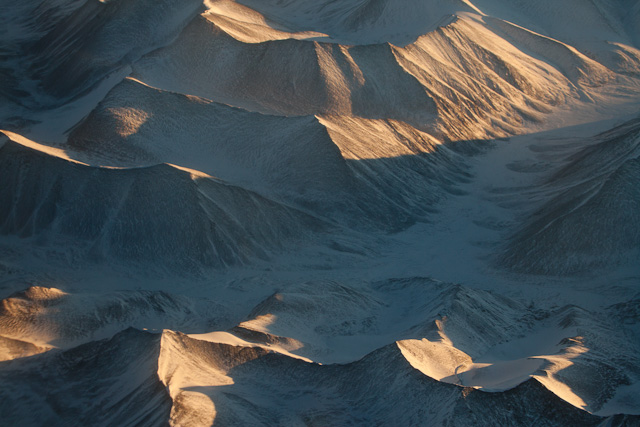
View from the flight - Delhi to Leh

It was the third week of January and the air was nippy as we departed from Delhi. We were a small bunch of mountain-enthusiasts heading to Ladakh that day, ready to brave the super-freezing temperatures in Leh with a wish to walk side-by-side along the mountain people of Zanskar Region on a river that freezes during in the winter months.

Other than our tour leader Manish Lakhani who was a veteran of Zanskar, none of us had an exposure to cold and arid winters in Ladakh. But warned well in advance and armed with sufficient information, we had boarded the flight with down jackets, multiple layers of clothing and thick boots that could help us land in -20C weather.

As I looked out from my plane’s window nearly half-an-hour a later, first rays of sun were striking the mountain peaks while the valleys and glaciers were still in shade. Flying at a height of 10,000 meters over the mountains that stood higher than 6,000 meters, it appeared as if we were flying dangerously close to ground level. It almost felt as if we could open the windows, let a hand down and touch some of the snowy peaks right below.

It was a quick and sharp landing in Leh with a jolt of breaking in the runway that is tucked away between the mountains. Indus River, seen from the top, was all frozen but for a few cracks where its deep blue colours disturbed a white blanket. It was -13C in Leh, but with our layers of clothes and insulation, it did not seem harsh.

chadar trek

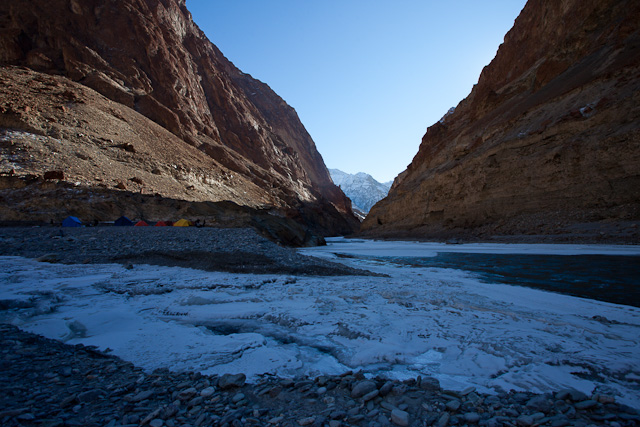
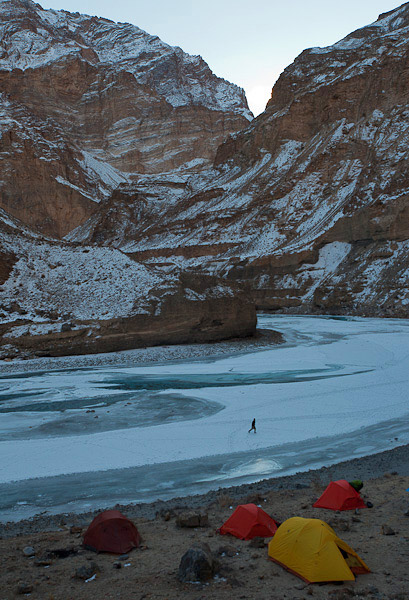
The first day’s camp after descending into the river and walking the first mile.

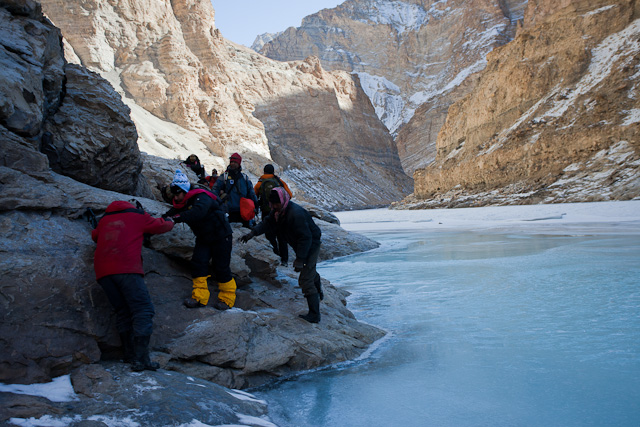
Two days later, we were struggling down a scree-slope nearly 60km from Leh as we descended into the Valley of Zanskar River. The river surface was frozen, but a strong current flowed underneath and kept us weary of encountering thin ice that could break and take us down. In places where the ice-shelf was broken, the deep-blue waters of Zanskar flowed invitingly, looking so beautiful that I would jump into it without much thinking, but for its forbiddingly frigid temperatures. The waters were so clear that every pebble was clearly visible even at a depth of ten feet.

The first ten minutes on the ice-shelf, it was as much falling on ice as it was walking. But in some time, we were getting used to our brittle chilkat shoes, got better at gauging the ice surface and managed to stay on two feet for longer periods. I myself prided in remaining literally infallible for a larger part of the trip until I came crashing in a relatively dangerous terrain on a steep slope.

chadar trek

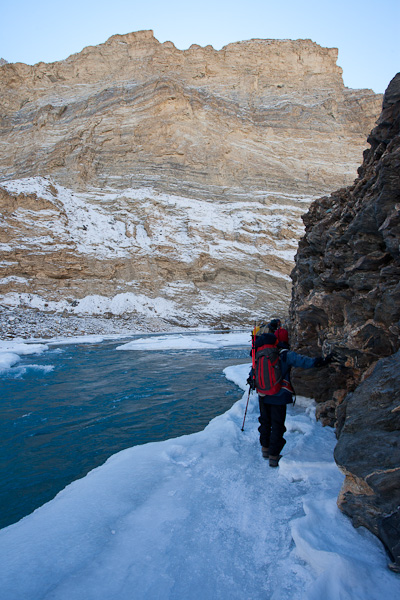
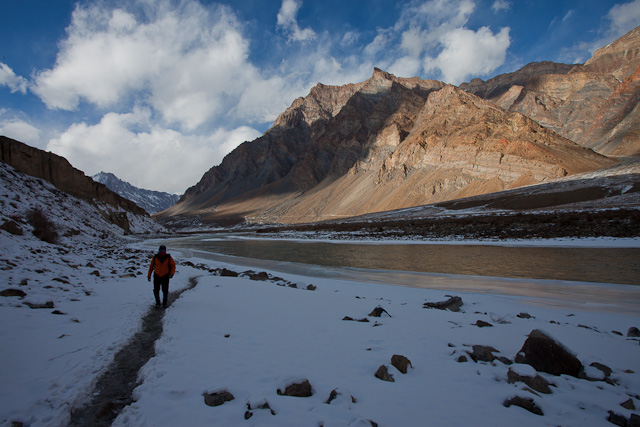
Walking on the tiny strip of frozen Zanskar River, next to the blue flow.

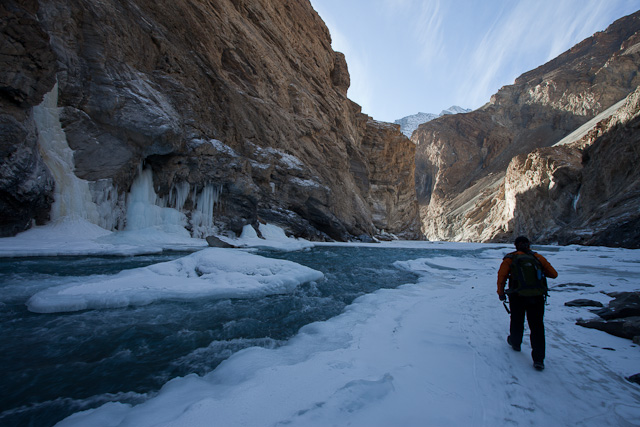
For the next five days, we treaded over the frozen waters everyday, waking up to a miserably cold morning everyday and packing all our stuff with great pain using our numbing hands. Our spirits would lift the moment we were on the ice-shelf, or Chadar, as it is popularly called. Our bodies would warm up as we walked and our spirits dulled by the night’s dipping temperature would get uplifted by the brilliant mountainous landscapes and the gurgle of Zanskar’s flow.

chadar trek

All along the way, our tour leader Manish would chant one mantra that the ‘chadar is unpredictable and changes every hour’. We would see powdery snow along the path one moment which would morph into rock solid slippery ice a little later. Sometimes we would be walking on perfectly good ice covering the river, only to encounter after some time just a thin patch of good ice on which we had to tread dangerously. The hardest hour of the trek was when we were trapped for a day at the bottom of a gorge with a completely broken Chadar, leaving no choice but to spend the night close to the river and hope for things to get better next morning.

chadar trek

Where the ice was thin, we had to go over the slopes. It was more difficult at some places, and at one point in time we had to spend a night wherever we were, hoping for the ice to form next morning.

Just like the condition of ice varied, the scenery kept changing by the hour and by the day. Sometimes we would walk along a narrow valley that would suddenly open up widely at the confluence of streams. Waterfalls would appear occasionally along the way, which dumped their waters straight into the river in summer months but were completely frozen and stuck to the wall in these cold winters.

chadar trek

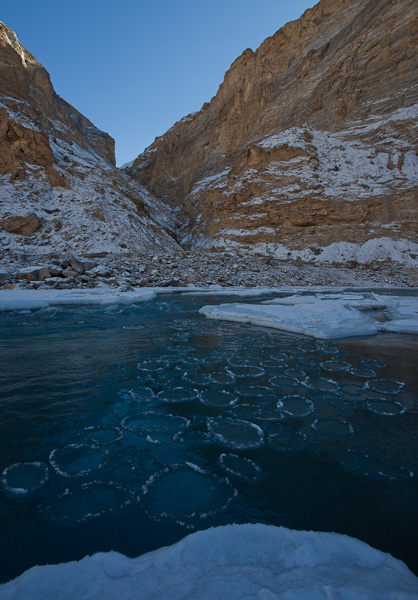
The bright sheet of snow and the blue waters were the only things that stayed constant with us all along. Sometimes emerging from a thick blanket of snow, the current carried tiny crystals of ice that floated on the river. My ‘aha’ moment of the trek came when I saw these crystal forming a bunch of crystal-lilies at a place where the water swirled at a corner, forming a small gathering of gently rotating discs of ice-crystals.

We encountered difficult times along the way when there was no ice in stretches and we had to find way through the slopes. These were the times when our infinitely agile and unbelievably strong Zanskari Porters came to our help. They would simply lift us on the shoulders and take us across shallow waters, so that we escaped the cold bite of the river. On precipitous slopes, they would climb up first, setup ropes and then belay us up carefully.

chadar trek

It is not just on the ice that our porters worked hard. They would march ahead and set our tents ready at the campsite before we arrived. On reaching a camp, we could always look forward to settling down in our comfortable tents with a hot cup of tea. Everything worked like a clock and we had things ready in our hands even before we needed it – be it something as important as a delicious dinner or a mug of hot water for freshening up in the morning. The porters and kitchen staff would pack the equipment and leave a campsite much after us in the morning, but would march ahead in no time to set things up for us at the next camp. Chadar Expedition would be much difficult without their heroics.

chadar trek

As we got closer to Padum, the valley widened and allowed us to walk over the slopes, leaving the river bed.

After six days of walking on the river, we reached the wide open valleys where civilization flourished once again and small villages dotted the mountain landscape. In here, for the first time during the trek, we left the river and walked along the slopes; we kept the tents folded and enjoyed the warm rooms in Zanskari Houses; we spread out from being huddled at the edge of the river and played soccer with the children in the villages. In two days that we spent in the open terrains of Padum, we forgot the ruggedness of the terrain and mingled with the smiling faces around us. But soon, it was time to go back. It was time to retrace the tough path on the ice within the confines of Zanskar’s steep mountains on either side of us.

chadar trek

Just like it used to be during the trek from Leh to the depths of Zanskar, Chadar kept changing and continued to throw challenges at us everyday on the way back. But time and again, our porters were there to lead from the front in the hour of difficulty. Weather gods too did their best and ensured that we had a smooth journey for a large part of our way back. It is thanks to the porters and good weather that we made it to Leh safely and in time to catch our flights home. As we took another quick flight over the mountain peaks enjoying the views below, we carried many fond memories – of smiling faces, enduring porters and breathtaking views that kept our company all through the expedition.

Below is a slideshow of images, presented at the Open Show, Bangalore on Chadar Trek.


Tweet Share
Subscribe to India Travel Blog | Email This Post Email This Post | 7 Comments

Related Posts

  • Sighting a Snow Leopard
  • Chadar Trek – Walking on the Frozen Zanskar River – January 2011
  • Cycling from Manali to Leh
  • Images – The Mountain Children of Indian Himalayas
  • Ladakh – Landscapes of the High Passes

Posted in Jammu and Kashmir, ladakh, mountains, rivers, trek
Tags: chadar expedition, chadar trek, ladakh, zanskar

The Ganga – Upstream Rishikesh

November 19, 2009

Valley of River Ganges near Rishikesh

Tweet Share
Subscribe to India Travel Blog | Email This Post Email This Post | Leave a Comment

Related Posts

  • Jageshwar
  • Grass and the Tree..
  • Compilation of Posts on Rishikesh
  • First Day at Auli
  • Rishikesh Information

Posted in hills, himalayas, mountains, photos, rivers, uttarakhand
Tags: himalayas, photo, rishikesh, uttarakhand

Ladakh – The complete guide to Leh – Manali Road – III
Rohtang Pass to Keylong

May 22, 2009

+ Series: Travel to Ladakh in July-August 2008
+ Previous: Ladakh – The complete guide to Leh – Manali Road – II
Manali to Rohtang Pass

+ Next: Ladakh – The complete guide to Leh – Manali Road – IV
Stopping at Keylong

Rohtang Pass is a place that marks many divides. To the south are the green slopes caressed by monsoons every year and to its north is a stark landscape often called the forbidden valley. Beyond Rohtang, the landscape begins to start resembling Tibetan, and so do the people. Temples give way to monasteries and Shiva makes way for Buddha. Apple orchards are replaced by potato and sweet peas. It is as if you just changed the DVD and a different movie started playing on the gigantic 16:9 screen.

Keylong

The fabulous setting of the town of Keylonw, Bhaga River and the road from Tandi

People north of Rohtang have an unusual pride about the altitude they live in. Every village along the way lays some special claims about its location. In Spiti Valley, a deviation on the Leh highway, people at Kibber Village once loved to call it as the highest permanent inhabitation in the world. When the record was broken somewhere else, they were not ready to give up. They came up with more possibilities instead: highest village with electricity, highest village with a motorable road, highest village with a post-office, and so on. A quick web search reveals all possible versions and may even give ideas to cook up new ones. Just below Kibber at the base of Spiti Valley, the petrol pump in Kaza doesn’t fall behind in making the ‘highest in the world’ claim.

Going past Keylong, probably every named place has something highest attached to it. It is only a matter of finding out highest ‘what’!? Indian Army takes bulk of the credits for creating all these highest hypes. In Pang, a tourist stopover on the way to Leh, is an army camp labeled as the “world’s highest transit camp.” Far north in Ladakh is Siachin glacier with its notorious claim for being the world’s highest battle field, where India and Pakistan have been fighting and wasting away lives and resources for a land that neither party can put to any good use. Once you have the privilege of making claims for world’s highest battlefield, the highest airfield is obviously not going to be far away. And Khardung-la, the world’s highest motorable pass doesn’t need any introductions. But Khardung-la’s days are probably numbered: everyone speaks of motorable passes in Ladakh and Tibet that raise much higher. I am sure they will find a new title for Khardung la when another pass officially becomes the highest motorable road.

That’s much digression from Rohtang Pass where we started from. It is a quick and steep descent from the pass, down to the valley of Chandra River. The small village of Khoksar next to the river is more a food court than a village. Dhabas line up the 100m or so length of the road, which is as long that the village spreads. A Himachal Pradesh Government PWD bungalow in the village may be open for visitors, but most people prefer to continue to Keylong. Despite the charm of Chandra River, Khoksar is not a pretty place and is too close to Manali for a halt.

Mountains of Keylong

Mighty mountain peaks seen from Keylong town

The way further is parallel to Chandra River, going downstream after crossing the river at Khoksar. It is usually muddy and flows swiftly in the months of July and August – the peak season for travelling to Ladakh. Photographs taken in later months show it in a deep hues of blue, a color that eludes most people who are on their way to Ladakh. The tall peaks along the way tend to have last snow of the season, and many tall waterfalls come down from the steep hills to merge with Chandra.

Tandi, 10km before Keylong has the last petrol pump on the highway. The road here turns right and continues along the valley of Bhaga River. A sign at the confluence of Chandra and Bhaga reads [not verbatim; recreated from memory]: “Welcome to Tandi, the confluence of blue waters of Chandra and green waters of Bhaga.” Unfortunately, the colours are all mixed up with plenty of earth, and what is there to see is two muddy currents coming together into one.

Chandra and Bhaga have an interesting origin. They both begin at different faces of the mountain at the same location – Baralach la. Chandra flows east and then turns west traversing through the valley of Lahaul, while Bhaga flows south through Darcha and Keylong. They meet again in Tandi, like two long lost sisters getting to see and hug each other. More like we see siblings separated at birth rejoining in an emotional drama in a Kannada movie, with the lead actor playing two roles.

Keylong is a quick 20 minutes drive upstream Bhaga River. It is the place where most people prefer to spend the night on the way to Leh, as we found out on arrival.

+ Previous: Ladakh – The complete guide to Leh – Manali Road – II
Manali to Rohtang Pass

+ Next: Ladakh – The complete guide to Leh – Manali Road – IV
Stopping at Keylong
Tweet Share
Subscribe to India Travel Blog | Email This Post Email This Post | 8 Comments

Related Posts

  • Cycling from Manali to Leh
  • Glimpses of Ladakh
  • Images: Shanti Stupa, Leh, Ladakh
  • Ladakh – Leh Cloudburst Distaster – Latest News, what happened and other details from the web
  • Tso Moriri Lake I – Leh to Korzok

Posted in hills, himachal pradesh, himalayas, ladakh, mountains, rivers
Tags: himachal, himachl pradesh, keylong, ladakh, leh, leh-manali

The Ganga Dream

May 7, 2008

One of my long standing dreams has been to swim in the Ganges.

I have been along the Ganga in various stages of her flow. When she is a youthful energetic self – agile and swift when coming down from the high mountains in Garhwal, below the snow line where she is colored turquoise in the wooded country and meanders through the mountains – much softer but still quick and seemingly in search of the plains, in Rishikesh where she widens her path and looks to stray from her channel that has remained narrow so far, and in Haridwar where she still retains her energy and purity as she cleanses thousands of pilgrims in the bathing ghats.

Map: Course of Ganga

She remains charming as ever all along and each time I step close to the bank, I am driven by an irresistible urge to jump in, swim along her course for a few miles and feel like the river myself. It has been a dream for many years now, since the first time I set sight on her in Rishikesh.

Ram Jhula, Rishikesh
Ganga at Rishikesh

The dream has remained unfulfilled, there was always something that held me back. She is a wild torrent and the water is frigid up in the mountains. She looks deep and just nice enough to float along with her in the mountains upstream of Rishikesh, but still flows fast and appears hostile. Ganga’s river bed has been reduced to a trickle in Haridwar by a dam and the swift currents in the narrow canals are not meant for swimming.

Varanasi boat ride
Ganga at Varanasi

I had my hopes on Varanasi. I knew she would be mild here and take her time to push through the plains to the ocean. I knew she would be deep enough that the river bed never runs dry in these parts. I had heard of its polluted waters but hoped it would be fit enough at least for a swim. I was eager to see the Ganga on my first visit to Varanasi.

But when I went there, the sight of Varanasi’s ghats was depressing. The river was not just unclean, but looked no different from a sewer. It was dark, nearly opaque and was filled with floating organic mass along the bank. At Assi ghat where the river makes a slight bend into the west bank, disposed trash made a thick layer that completely covered the surface. Forget swimming, even touching the water seemed unthinkable.

But pious pilgrims who arrive here seem to be unmindful, which surprises me. Their faith must be a really strong to be able to callously step into the murky river and be at ease during the ritual bath.

A friend who was recently in Varanasi was taken aback by the response when she asked someone if they are not troubled by the pollution in the river.

“Ganga is intrinsically pure,” she was told, “there is no way it can be polluted, no matter what gets mixed into it.”

‘Ganga Ma’ was loved as is, no matter what state her waters were in. But I had met a few people who were more concerned. A man I was speaking to who was on a pilgrimage was deeply concerned. “You must be feeling sad about all that is happening to the Ganga,” he told me, “see what we are doing to our mother.”

Despite seeing hundreds of people taking a dip or go swimming in the river, I did not have the courage to jump. When I returned from there, my wish remained unfulfilled. I shall be going back to Rishikesh some day, and when I do, I shall go rafting and drift down the river and hopefully get to swim in it’s friendly stretches.

Tweet Share
Subscribe to India Travel Blog | Email This Post Email This Post | 13 Comments

Related Posts

  • An Evening at Ganga Aarti, Haridwar

Posted in rivers, uttarakhand
Tags: ganga, ganges
« Previous Entries
  RSS
twitter facebook

Also see: Complete List of Destinations


_______________________________________

Featured

  • Complete List of Destinations
  • Places around Bangalore
  • Places around Delhi
  • Driving from Bangalore to Goa
  • Tour of Coorg
  • Auli
  • Sikkim
  • Driving from Manali to Leh
  • Leh, Ladakh - start of the series
  • Leh, Ladakh - index to all stories
  • Rajasthan Tour
  • Travel to North East India

Photography

  • photography services in Bangalore
  • interior photography
  • travel photography
  • product and industrial photography
  • travel images for editorial use

_______________________________________

Plan Your Holiday


Book or request for details for customized holidays and packages with our partners 'Holiday Mantra' in the above destinations or anywhere else in the country. Ph: +91-9482643109
  • Your Name

    Your Email

    Telephone Number

    Destination/Property you intend to visit

    Subject

    Your Message (please indicate the name of the accommodation you want to book if any, your budget, location, dates, number of people and any other preferences you have. More details the better!)

    captcha

    ajax loader

_______________________________________

about:me
Arun
Travel Writer and Photographer,Bangalore, India.
contact me for queries, photography assignments and travel writing

+ See my Freelance Travel Writer Resume
+ See my photography portfolio - contact me for your photography needs for shooting travel images, interiors and architecture, products, industrial and events.
+ Visit my india image gallery to source images for editorial use or to buy photo prints.

_______________________________________

Links: Travel Blogs and Sites
_______________________________________

Categories

  • darter
  • Others
    • book review
    • calendar
    • meta
    • misc
    • newsletter
    • travelwise
  • photo essay
  • photography tours
  • photos
  • Regions
    • bangalore
    • himalayas
    • ladakh
    • lahaul and spiti
    • sahyadri
  • States
    • arunachal pradesh
    • assam
    • Delhi
    • gujarat
    • himachal pradesh
    • Jammu and Kashmir
    • karnataka
    • kerala
    • Madhya Pradesh
    • meghalaya
    • north east
    • north-east india
    • rajasthan
    • Sikkim
    • tamil nadu
    • tamilnadu
    • Uttar Pradesh
    • uttarakhand
  • Themes
    • beach
    • birds
    • culture
    • driving
    • heritage
    • hills
    • humour and travel essays
    • monsoons
    • mountains
    • nature
    • picnic
    • rivers
    • trek
    • walks
    • wildlife
  • travel photography
  • travel tips
  • Uncategorized
  • video
_______________________________________

Our holiday planning partners - Holiday Mantra
_______________________________________

auli badami bangalore birds book review books calendar coorg corbett darter driving friday photo himachal himachal pradesh himalayas hoysala jaipur kanha karnataka kaveri kerala ladakh lahaul and spiti leh manali meta monsoon newsletter north-east india north east photo photo essay photography picnic rajasthan rishikesh shimla travel photography tso moriri uttarakhand uttaranchal varanasi walks walks in india wildlife

_______________________________________


Featured India Blog on GO! Overseas

Travel Blogs - Blog Top Sites Visit blogadda.com to discover Indian blogs
newsletter powered by Dada Mail
travel home
.


© 2004-9 paintedstork.com All rights reserved. Contact