India Travel Blog

Photography Tours and Workshops

* Photography Workshops
-- Bangalore June 9-10, Hyderabad May 26-27
* Africa - Great Migration
-- Kenya, Aug 12-19
* Rainforest Wildlife. Agumbe, June 15-17
* Himalayas. Lahaul & Spiti, July 14-21


 search paintedstork.com


Blog Home    |    Photography Services    |    All Destinations    |    India Image Gallery    |    Buy photo prints    |    About    |    Contact

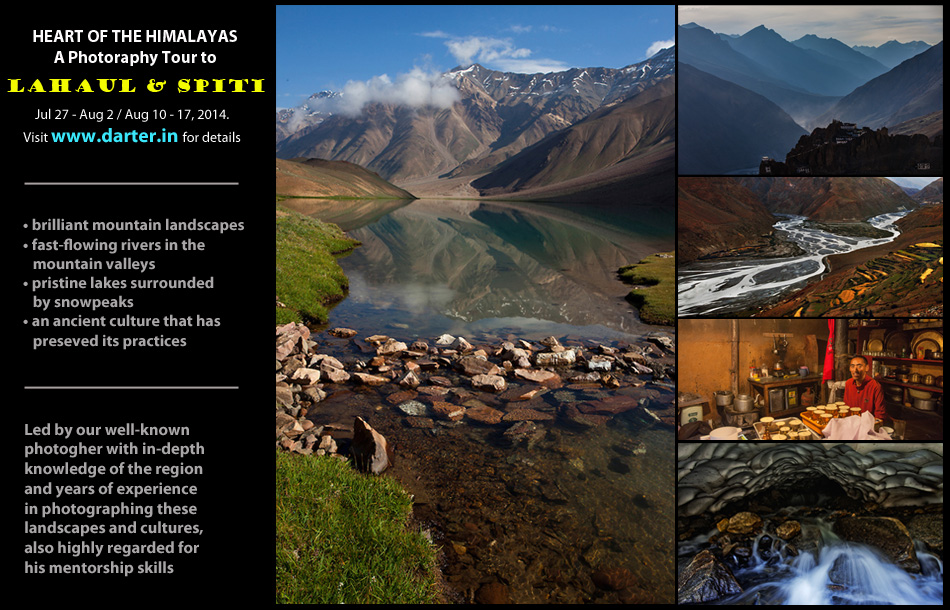
Heart of the Himalayas – A Photography Trek + Tour of Lahaul and Spiti

March 29, 2012

Our next grand tour is to the mountain lands and the Buddhist monasteries of Lahaul and Spiti. I will be leading this tour to see and photograph the most beautiful places you can ever see in the Himalayas and to Buddhist monastic centers that are nearly a millennium old.

Dates: July 14th to 21st, 2012

Introduction

chandratal lake, lahaul and spitiOne of the still unexplored and insanely beautiful stretch of the Indian Himalayas, Lahaul and Spiti is a valley of stark landscapes and high snowy peaks stretching to the sky. Gurgling rivers and crystal clear lakes dot the highlands of Lahaul, while an ancient civilization has survived for nearly thousand years and has preserved its culture against the onslaught of modernity in Spiti. The faraway valley connected only through a narrow road that traverses through mountains over 10,000 feet high, this region offers vistas and heritage that can keep a travel photographer in a click-frenzy for months together.

Scroll down to see the day-by-day itinerary to know more details and get a glimpse of incredibleness of Lahaul and Spiti Region.

Tour Highlights

  • Easy, short duration treks specifically helpful for photography
  • Camping in the heart of the mountains, near the clear blue expanse of Chandratal Lake surrounded by high peaks.
  • Drive through some of the most amazing landscapes in one of the remotest regions in the Indian Himalayas.
  • See and photograph the views from high passes of Rohtang and Kunzum La
  • Visit the Buddhist monasteries more than 800 years old that have followed an ancient tradition of Tibetan Buddhism.
  • Visit to sights specifically chosen keeping photography opportunities in mind
  • Expert help and advice with photographing culture and landscapes of Lahaul and Spiti
  • Constant interaction and assistance on field by photography experts with an experience of travelling in Lahaul and Spiti
  • Insights to nuances of travel and outdoor photography during the tour
  • Image reviews by photography experts

See full details of the tour - Heart of the Himalayas – A Photography Trek + Tour of Lahaul and Spiti

Tweet Share
Subscribe to India Travel Blog | Email This Post Email This Post | Leave a Comment

Related Posts

  • Lahaul – driving to Batal
  • Images – The Mountain Children of Indian Himalayas
  • Workshop – Photographing Landscapes
  • Beautiful India – Images of landscapes
  • Lahaul and Spiti

Posted in darter, himachal pradesh, himalayas, lahaul and spiti, photography tours
Tags: himachal pradesh, lahaul, photography, spiti

Lahaul and Spiti

June 20, 2011

+ This is an article on Lahaul and Spiti earlier published by Kansai Timeout, Japan
+ Also see: Our tour to Lahaul and Spiti in July

“It is so beautiful that you will find it difficult to come back,” said our cab driver Mangal Singh as we drove towards Lahual and Spiti region in the highlands of Indian Himalayas. I looked up and saw his beaming face and wondered if it was just a marketing pitch or a genuine remark. His brightly lit eyes expressed confidence that we would have a good time, and his warm smile and friendly gesture melted my doubts away.

Driving over the last mountain pass on our way at over 13,000 feet, we are suddenly led into no man’s land as we enter into the valley of Lahaul. Civilization and hustle bustle of the everyday world is left behind and completely forgotten in its silence. There are no houses, no people, no vehicles to give way to, or anything to remind of the world we have left behind. A narrow road barely good enough to drive reminds that we are still connected with the world, and also gives us access to the terrain that almost feels uncharted.

lahaul and spiti

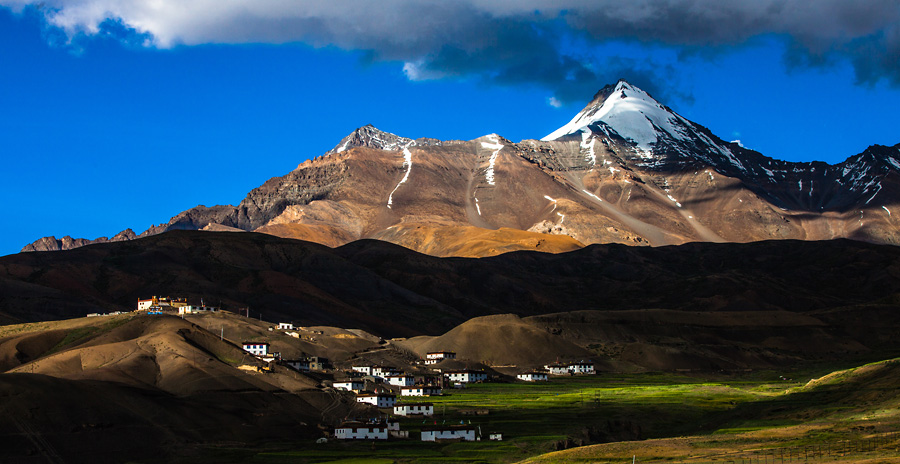
Lahaul and Spiti region is a desert in the higher ranges of Indian Himalayas, where nothing more than tiny grass a few inches tall grows. Muddy brown mountain surface stretches as far as the eyes can see, and the peaks keep growing taller and taller as we look ahead. Moisture laden clouds from the south are blocked by Pir Panjal ranges of the Himalayan mountains, ensuring that it never rains in these parts.

Condition of the road deteriorates quickly on entering Lahaul. Soil is loose and keeps shifting, ensuring that freshly laid tarmac doesn’t even last for a year. Driving involves wading through streams originating from melting snow, which run across the road in a bid to meet Chandra River far below in the valley. Sections of the road are narrow enough to barely let a jeep pass, and any error in judgment would only mean tumbling down the valley and into the fast flowing river. Yet, there are hardly any accidents, thanks to little traffic and the drivers who are used to these roads.

lahaul and spiti

There was no permanent habitation sighted on the journey for next eight hours of our drive. The road passes along lines of tall mountains forming a narrow valley bisected by Chandra River. Mountain peaks are dressed in snow that would soon melt and bare it all in high summer. Nomadic shepherds wander this forbidding land during the warm seasons in search of narrows plateaus where nothing more than bits of tiny grass grows. Herds of sheep seem to be content with just this grass and survive effortlessly, and the shepherds survive on sheep.

lahaul and spiti

Our accommodation for that night was very basic, in a tiny one-family village called Batal. An elderly Buddhist couple and their helper who ran the place had arrived here for the summer from warmer climes and had re-opened the hotel only a week ago. They were a friendly lot and effortlessly broke into conversations even as they cooked our dinner. They made us burst into spells of laughter with their jokes every now and then, and kept us in good spirits despite the cold weather. “You are too early in the season,” said the man of house, “you should come here after a few more weeks, it will be nice and warm.” He pointed to my thick sweater and woolen cap and laughed out loud when I told him I was feeling comfortable.

chandratal lake

Our next morning drive to Chandratal – a high altitude lake – left me with an interminable affection to the region. The turquoise blue lake is surrounded by mountains all around it but for a narrow passage that drains its waters. Its calm surface reflects the snowy peaks and clear blue sky like a perfectly polished mirror. Its clear water is transparent and the ground far below in its depths is easily visible. An urge to jump in for a swim is curtailed only by the temperature of the water, which is close to freezing point.

chandratal lake

Further, we crossed-over the mountains of Lahual into Spiti Valley through Kunzum Pass at nearly 15,000 feet, the highest point in our journey. The mountain pass hosts a small temple for the local goddess Kunzum Devi. Whether the pass derived its name from the temple or the other way is not known, there was no one to tell us about it and neither did our driver Singh know. Walking barefoot on the cold ground was not exactly my idea of fun, but I could not resist going inside to have a look, for which I had to remove the shoes. The temple was empty and there was no evidence of anyone having been there in the past few days.

spiti valley

Landscape of Spiti Valley is remarkably different from Lahaul. The floor of the valley is wide and has a lot more vegetation. Straight, easy to drive asphalted roads took us through Losar, the first village in Spiti and then to Kaza town. Villages appeared on the road every now and then, and there were a few people waiting on the road for transport to Kaza. This was a complete change from the uninhabitable terrains of Lahaul.

Ki Monastery

Spiti is a land of ancient Buddhist monasteries that are as old as thousand years. One of those, Ki Monastery is over 800 years old, but most of the buildings are new and there is no visible evidence of its past. The buildings that stand today are made of white washed mud plaster and wood to support the roof. More buildings, built with concrete, are coming up in the periphery to accommodate more students as well as travellers.

ki monastery

A friendly monk with a round mongoloid face, small blood-shot eyes and bugling cheeks welcomed us and escorted us inside. He spoke with a deep high pitch voice that seemed to be coming from the bottom of his larynx.

The monastery is spread around a prayer hall where the monks assembled. A few deities of worship, a kitchen and smaller prayer room surround the prayer hall. An old kitchen built many centuries ago still exists, though not used anymore. Our escort monk showed us the utensils of yesteryears and asked to take a seat on a bench in the center. ‘These days we use this room to honor the guests,’ he said and poured us tea from a pot. Over the tea, I questioned in him length about the past and present of the monastery.

‘Life was much difficult before,’ he explained and spoke in length, ‘it was not easy to procure food and other daily needs, but now the government helps us. Procuring fuel and wood was a big problem, since there are no trees here. Things are much better these days; we are well connected and well provided. There is a problem of good teachers though, Tibetan preachers don’t get visa easily and we will have to manage with local ones.’

I barraged him with many question. ‘Why is your monastery located in such remote place? Why are you so far away from civilization? Why do monasteries tend to be in some far away mountain or top of a hill?’ There were simply too many questions I wanted answers for.

The rain of questions was probably hard on him, but he was patient. He took some time to think over it and said, ‘it is to escape from the everyday world.’ I waited for him to continue but he did not seem to have more to say on it.

He escorted us back to the entrance after the tea, and humbly welcomed us to visit again. The goodness and hospitality of the people of hills never ceases to amuse me. ‘We have rooms to stay for tourists,’ he said, ‘next time you come, do stay with us.’ Despite the hardships of the terrain and difficult conditions they live in, they are congenial and helpful even to strangers.

spiti valley

At Tabo village, a couple of hour’s drive from Ki is another monastery that is more than a thousand years old and is known for its well-preserved frescoes. The monastery’s prayer hall, called Tuglhakhang, is richly decorated with frescoes in vibrant colors. A set of nine small temples built with mud surround the prayer hall, each decorated with paintings of incarnations of Buddha and Tibetan deities. The daily activities of the monastery are performed in a new building built beside the temple complex, leaving the ancient structure preserved. The remains of the old monastery and the frescoes are now declared as a UNESCO world heritage center.

We drove further from Tabo next day and into lower regions of Himalayas, exiting Spiti from other end of the valley. But in the next few days we were on the road, we kept repenting about having left the majestic valleys of Lahaul and Spiti so early, and yearned to be back there. Mangal’s words – “It is so beautiful that you will find it difficult to come back”, kept haunting us all the way.

Tweet Share
Subscribe to India Travel Blog | Email This Post Email This Post | 4 Comments

Related Posts

  • Heart of the Himalayas – A Photography Trek + Tour of Lahaul and Spiti
  • Lahaul & Spiti Valley – Tabo Monastery and Nako Village
  • Kunzum La – Kaza – Ki Monastery – Kibber Village
  • Images – Batal and Chandratal
  • Lahaul – driving to Batal

Posted in himachal pradesh, himalayas, lahaul and spiti, mountains, Uncategorized
Tags: chandratal, himachal pradesh, kaza, ki monastery, kunzum la, lahaul and spiti, spiti valley

Three Days in McLeodGanj – III

April 4, 2011

Also see part I and part II

As I walked through cedar groves, grassy slopes and small lanes with cafes selling cappucchinos in McLeodGanj, I was distinctly aware of a few things I was going to miss during my visit. I so wished to see and listen to His Holiness, who was away travelling on the days I was in the town. I also wished to go higher into the mountains, visiting the snowline and go beyond with Gaddi Shepherds, exploring the highland pastures in Dhauladhars. All of them will have to wait for another visit – my stay at McLeodGanj this time was going to be a short one, allowing me just some glimpses of its beauty.

mcleodganj

And beautiful were the town and its surroundings. I wandered the streets watching smiling monks in ochre robes walk by, chanting slowly as they turned their prayer wheels or counted rosaries. The shops along the narrow lanes sold prayer flags, thangkas, small prayer wheels, cham-dance -masks and everything that can be sold to devout Tibetans as well as the tourist looking to carry home some memories. Modern-looking restaurants frequented these roads, selling garlic bread, lemon tart and apple cakes. The option in cuisines were wide enough to take you on a world-tour-in-a-day, starting from Indian and offering Mediterranean, Italian, Japanese, Mexican and anything else you can imagine.

mcleodganj

In the middle of these was a bright gilded shrine that was visible from most parts of the small Temple Road. An array of prayer wheels dotted the walls of this shrine, occasionally visited by elderly men who walked slowly as they turned the wheel. I walked behind them, turned a large number wheels in on stroke and watched the brightly painted sacred letters – om-mani-padmeham go round and round on one wheel after the other.

mcleodganj

I walked out from the town downhill, in the direction of Forsyth Ganj along the main road connecting McLeodGanj with rest of the world. It is a main-road for name’s sake but was quiet and vehicle free, ideal for long walks but convenient enough to catch the next bus when the legs give away. I was looking forward to visit ‘St.John in the Wilderness’ – a quaint church introduced to me by Shalabh. To repeat his words on the history of the church: “First built in 1852 in neo-Gothic architecture and repaired multiple times subsequently, the cathedral’s graveyard is also the final resting place of Lord Elgin, viceroy of India from 1862-1863. The church is known for its Lady Elgin donated Belgian stained glass windows. Also of note is the church bell, made by Mears and Stainbank Founders, London, installed in July 1915. This church bell replaced the bell tower destroyed in the 1905 Kangra earthquake. Set in a thick, old Deodar jungle with its collection of old graves, the church yard seems to take you into a bygone era.”

The Church is a small hall with its own history, whose location in a cedar grove is as charming as the church itself. A small grave behind the church has plenty of history buried under it, but it was such a pleasure being in this forest and wandering freely as the legs decide, I allowed history to take backseat.

mcleodganj

That evening, my last day in Ganj, I made a quick visit to Bhagsu Waterfall before rushing to catch my bus. The walk to the falls is through a small alley past the ancient Bhagsu Temple, passing through shops selling merchandise of worship. Going past these settlements, McLeodGanj offers more possibilities as the bridle path to the fall opens up to the vista of beautiful hills and small paths leading into the heart of the mountains. I thought of walking farther and farther, past the cleverly named “No Name Cafe” and into the cedar trees beyond to explore the higher regions in the Dhauladhar. The Ganj needs another, longer visit.

End of series.

Tweet Share
Subscribe to India Travel Blog | Email This Post Email This Post | 4 Comments

Related Posts

  • Three Days in McLeodGanj – II
  • Tibetan Buddhism at Dharamsala
  • Video: Carving Mani Stones
  • Heart of the Himalayas – A Photography Trek + Tour of Lahaul and Spiti
  • Images – The Mountain Children of Indian Himalayas

Posted in himachal pradesh, himalayas, Uncategorized
Tags: dharamsala, himachal pradesh

Three Days in McLeodGanj – II

April 3, 2011

See part I and part III

My long walks lead me several times to the abode of Dalai Lama in search of the charm that attracts thousands of people to this small town in the Himalayas. A narrow long passage and empty hallways greeted me to a prayer hall colourfully decorated like every Tibetan Monastery is. The open spaces around the prayer hall, perhaps teeming with people on some days to listen to the lectures of His Holiness, now remained silent but for the laughter of a few tourists and murmuring chants of monks passing by.

His Holiness himself was away and travelling as he normally is for most days of the year. For a moment the open surroundings of the temple appeared to have little of interest in the absence of Dalai Lama. The prayer halls were empty and I did not feel a sense of belonging that I hoped to experience in his abode. I sauntered aimlessly from one end of the temple to other,watching the few tourists who made a quick tour of the temple and the genial monks with rosaries humming their chants. A small number of devout Tibetans prostrated repeatedly in front of the prayer hall, bowing down and coming up again and again, sometime joined by western faces coming under Richard-Gere-like influence from Buddhist preachings. Many of the prostrating Tibetans appeared calm and contented, offering unrequited devotion to their spiritual leader and to the forces of the other world. But a few faces gave away a hint of anxiety and pain, perhaps towards their kins suffering from suppression in their homeland.

dalai lama temple at McLeodganj

A small museum, curated by men who escaped from Tibet to India, tells the story and state of Tibetan People in their homeland today. The displays at the museum show images of Tibetan warriors trying to face People’s Liberation Army, images of Chinese Soldiers in the plateau, the stories of Tibetans escaping through high passes buried in snow, destroyed monasteries and forced education that children now go through.

mcleodganj

Hot momos anyone?

Walking past the Dalai Lama Temple, stopping briefly to buy freshly baked potato momos from Tibetan Women who sold it on the street, I dragged my feet downhill to discover a circumambulation path around the temple. A small paved path went through a cedar grove behind the temple, taken by a few monks and worldly Tibetan but rarely any tourists. The quiet, green path through the slopes was decorated with brightly couloured prayer flags and painted mani-stones. A few minutes of walking, I stumbled into two monks carefully carving the stones with the sacred mantra – ‘Om Mani Padmeham,’ working the chisel slowly on the rocks and stopping occasionally for a conversation with passing monks.

mcleodganj

Further along the path was a small place of worship next to a home for Tibetan senior citizens. In front of this were a few stupas placed haphazardly along the slopes, surrounded by a riot of colourful prayer flags that added a cheerfulness touch to the circumambulation path.

mcleodganj

Beyond this was a thick vegetation where I spent nearly an hour looking at several birds which I had never seen before and never known their names before arriving at the gates of the temple again.

Tweet Share
Subscribe to India Travel Blog | Email This Post Email This Post | Leave a Comment

Related Posts

  • Three Days in McLeodGanj – III
  • Tibetan Buddhism at Dharamsala
  • Video: Carving Mani Stones
  • Heart of the Himalayas – A Photography Trek + Tour of Lahaul and Spiti
  • Images – The Mountain Children of Indian Himalayas

Posted in himachal pradesh, himalayas, Uncategorized
Tags: dharamsala, himachal pradesh
« Previous Entries
  RSS
twitter facebook

Also see: Complete List of Destinations


_______________________________________

Featured

  • Complete List of Destinations
  • Places around Bangalore
  • Places around Delhi
  • Driving from Bangalore to Goa
  • Tour of Coorg
  • Auli
  • Sikkim
  • Driving from Manali to Leh
  • Leh, Ladakh - start of the series
  • Leh, Ladakh - index to all stories
  • Rajasthan Tour
  • Travel to North East India

Photography

  • photography services in Bangalore
  • interior photography
  • travel photography
  • product and industrial photography
  • travel images for editorial use

_______________________________________

Plan Your Holiday


Book or request for details for customized holidays and packages with our partners 'Holiday Mantra' in the above destinations or anywhere else in the country. Ph: +91-9482643109
  • Your Name

    Your Email

    Telephone Number

    Destination/Property you intend to visit

    Subject

    Your Message (please indicate the name of the accommodation you want to book if any, your budget, location, dates, number of people and any other preferences you have. More details the better!)

    captcha

    ajax loader

_______________________________________

about:me
Arun
Travel Writer and Photographer,Bangalore, India.
contact me for queries, photography assignments and travel writing

+ See my Freelance Travel Writer Resume
+ See my photography portfolio - contact me for your photography needs for shooting travel images, interiors and architecture, products, industrial and events.
+ Visit my india image gallery to source images for editorial use or to buy photo prints.

_______________________________________

Links: Travel Blogs and Sites
_______________________________________

Categories

  • darter
  • Others
    • book review
    • calendar
    • meta
    • misc
    • newsletter
    • travelwise
  • photo essay
  • photography tours
  • photos
  • Regions
    • bangalore
    • himalayas
    • ladakh
    • lahaul and spiti
    • sahyadri
  • States
    • arunachal pradesh
    • assam
    • Delhi
    • gujarat
    • himachal pradesh
    • Jammu and Kashmir
    • karnataka
    • kerala
    • Madhya Pradesh
    • meghalaya
    • north east
    • north-east india
    • rajasthan
    • Sikkim
    • tamil nadu
    • tamilnadu
    • Uttar Pradesh
    • uttarakhand
  • Themes
    • beach
    • birds
    • culture
    • driving
    • heritage
    • hills
    • humour and travel essays
    • monsoons
    • mountains
    • nature
    • picnic
    • rivers
    • trek
    • walks
    • wildlife
  • travel photography
  • travel tips
  • Uncategorized
  • video
_______________________________________

Our holiday planning partners - Holiday Mantra
_______________________________________

auli badami bangalore birds book review books calendar coorg corbett darter driving friday photo himachal himachal pradesh himalayas hoysala jaipur kanha karnataka kaveri kerala ladakh lahaul and spiti leh manali meta monsoon newsletter north-east india north east photo photo essay photography picnic rajasthan rishikesh shimla travel photography tso moriri uttarakhand uttaranchal varanasi walks walks in india wildlife

_______________________________________


Featured India Blog on GO! Overseas

Travel Blogs - Blog Top Sites Visit blogadda.com to discover Indian blogs
newsletter powered by Dada Mail
travel home
.


© 2004-9 paintedstork.com All rights reserved. Contact