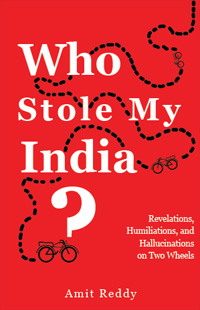
 Book Title: Who Stole My India
Author: Amit Reddy
Pages: 453
Amit Reddy was probably born in the wrong place. Even his mother thinks so when she says, ‘You should go away to America, You are nothing like Indian.’ As Reddy finds it difficult to understand and live a life that his society and surroundings expect him to, and unable to comprehend the diktat of a Hindu Indian society, he decides to fix the problem. The way he decides to do it is by travelling across the country to discover its soul, and perhaps discover his own soul that might fit within an Indian context.
As he puts it, “It’s all so frightfully confusing, but I intend to rectify this situation. The plan is ingenious, and quite simple. I’m going to explore India like few people ever have, by taking an inordinately long journey around the country; 40,750 kilometers long, to be precise… If everything goes accordingly, by the end of this journey I hope to be the complete Indian.”
He begins from Hyderabad on Kaya–a much loved motorcycle that is usually addressed as an animate being–and rides into nearly every Indian state. The journey takes him through wilderness, rugged terrains, temple-towns, remote villages, mountainous landscapes, deserts and the sprawling cities. This book isn’t about those places though, but on people Reddy meets and the way of life in India as witnessed by him.
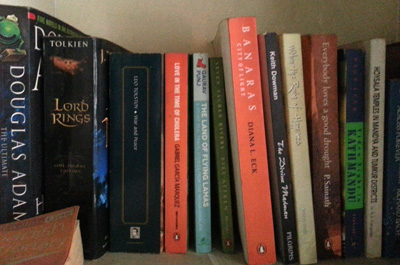 A good friend asked me to make a list of ten books that have had a profound impact on my life. I thought it will take a long time for me to come up with the ten list. But it filled up really quickly, and left me wishing that I had room for more. Culling down to ten books was not easy, especially when you have spent a good part of your life reading books. Naturally, more recent books are fresh in memory and end up appearing, though it shouldn’t ideally be so. On to the list.
1. Sacred Waters by Stephen Alter. This is a little known book. But whenever I make a book list, this never fails to make it to the list. One day, after much planning, Alter leaves his watch behind in his Dehradun Home and heads up the mountain with a backpack. Six months (non-contiguous) of travels by foot into the mountains follow, into the sacred char dhams and the most beautiful and sacred mountainous places in today’s Uttarakhand. His experiences left me with a longing, and to some extent, helped me shape my own life full of journeys. I would also wholeheartedly recommend another book of his–Elephas Maximus–although it doesn’t make it to my ten.
2. Looptail by Bruce Poon Tip. This is one of the recent books I have read and there may be a freshness-in-the-mind bias in putting this into the list. Bruce Poon Tip is the founder and CEO of G Adventure, a travel company. Having founded a travel company and having tasted some success in the venture, I was searching for the way forward, direction in which the enterprise should move and the values we should uphold. I was also ridden with an inherent wish and need to make our acts ecologically sustainable and socially meaningful. Answers wouldn’t come inherently and existing with unanswered questions wasn’t easy. Looptail answered many of those questions that kept ringing in my head, and showed light into a path that could be taken. Not that I am walking the path this moment, but I know the directions and I am walking that way now, thanks to Looptail. Another book that helped me to find answers is Richard Branson’s ‘Business Stripped Bare’, though I wouldn’t put it in my ten list.
3. Animal Farm by George Orwell. A book that put me to reflect deeply on human societies, forms of governance et al. The generously used quote, ‘All are equal, but some are more equal than others,’ probably originates from this novel. Orwell knows how to dig the hidden dirt and bare it all for everyone to see. Brilliant, any day.
4. Narada Bhakti Sutra and Shiva Sutra. The saying goes that these are written by those after whom they are named. The sutras are so cryptic, and in a language that can miserably fail a literal translation. So one needs to read a descriptive interpretation to make sense of what is written there. The interpretations I read were made by Sri Sri Ravi Shankar, and I believe they were very well done. Reading the sutras help scratch a bit of the surface of the mystery of us, the universe, and the enigmatic questions that do not have simple answers. I don’t think I have realized what is written there, but I think I have understood and made sense of it a bit, applied a bit of what is said and found them valuable.
5. Siddhartha by Hermann Hesse. Despite more than a decade since reading the book, I still draw lessons in everyday life from Siddartha. Like two days ago for example, when the auto-rickshaw meter decided to sprint instead of the marathon it should have made. I took it calm, completed the transaction without letting my brains heat up, but promptly lodged a complaint after coming home. Siddhartha is an inspiration to live a calm, confident and sat-chit-ananda life; erring auto-drivers be damned!
6. Photography books by two Johns – John Shaw and John Hedgecoe. In those times when you had to put a 36mm film roll into a camera to make photographs, learning photography was not easy. If making good photographs is difficult today, it was a miserable hardship in those olden days. Many books written by Johns–I will not go into individual titles–helped me understand photography, put structure into my thinking and provided the first sprinkles of water into the seed of photography that I had sown as early as in m childhood. The books may be sort of redundant (or may be not) in today’s digital world, but in an era when digital technology was almost not existing and internet hadn’t proliferated, these books helped me go a long long way. If you are taking nascent steps into photography, inundated with excessed of information online and do not prefer to learn from others, you should still consider these books.
7. Hitchhiker’s Guide to the Galaxy by Douglas Adams. The book that taught me not to take life seriously and kept me deliriously happy all through the time I was reading this. A book of this order can’t be written by an ordinary human being. You can’t pack so much of wisdom and so much of humor between two covers unless your name is Douglas Adams. Another book that stands equally high is Catch 22 by Joseph Heller; falls just a notch below H2G2 though I am sure someone else may reverse this order.
8. Works of Ruskin Bond. Another writer who makes me overjoyed when reading through his works. Who else can turn reading about a simple life in the hill into cherished experiences? Everything he writes comes with a child-like innocence that only Bond can possess. It is such a joy to read about his walks in Mussorie, his sorties in the hills or his pauses to smell the flowers. He brings the Himalayas alive and makes the mountains smile for you.
9. Works of SL Bhyrappa. Sakshi, Parva, Bhitti, Saartha, Nirakarana, Daatu,… I don’t think I have read any one other author’s so many works (Except may be Ruskin Bond, of whom there were too many compiled works, thanks to Penguin). Each one of his works is filled with profound thoughts, often churning the deeply established and well-entrenched ideas of the social systems, often asking profound questions without being in a hurry to impose prejudiced answers. Bhyrappa’s works have helped me shape ideas of a social order, have helped me ask questions without having to oblige myself into settling to an answer and have forced me not to accept anything at face value. His works often leave questions that linger in my mind long after the book is finished.
10. Video Nights in Kathmandu by Pico Iyer. A travel book that makes every other travel book appear too shallow. Iyer’s book–a traveller’s insights to cultural influences of the West in Asia–is gem of a read. This is a book that every writer, or aspiring writer in the genre of travel must read and set the gold standard to. The book is so brilliant, (I feel) Iyer himself failed to produce any more works that matched its awesomeness.
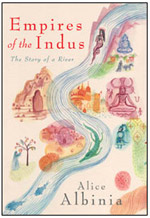 Title: Empires of the Indus
Author: Alice Albinia
Empires of the Indus is a story of people from the past and present of the Indus Valley. Author Alice Albinia makes the long journey from the delta of Indus at Karachi to its origin in Tibet, searching for the river’s past and reflecting on its present. She treads upstream slowly, often stopping for long periods and making long detours looking for a piece of history or culture.
Her journey begins at Karachi, where she spends her time meeting people who have lived here forever and also the ones who arrived from India after the British left, and exploring the changes that the city went through after Pakistan gained independence. She makes a slow journey upstream Indus on a boat visiting indigenous cultures and understanding their ways of life.
The story moves slowly into the past as she moves upstream. The clock moves back to the days of British Empire, unfolding the story of British struggle to explore and map the Indus and to conquer the local rulers. Further, it moves to the past where Islamic rulers dominated the landscapes and eventually to Alexander’s invasion to India. She also makes detours to the dangerous terrains in Afghanistan, crossing the border from Pakistan a few times. As she moves up the mountains, story shifts towards Buddhism and eventually to the aboriginal people and cultures. Later, the author spends considerable amount of time exploring the rock carvings and clues from paleolithic age when she is in Swat, Chitral and Ladakh. But once up in Tibet, her focus narrows down to merely making the adventurous journey to the source of Indus in the unforgiving terrain.
Throughout the book, the reader clearly sees the great commitment and effort that the author has made to extract the stories, meet the people who have information and visit every part of Indus Valley that has any significance to her chronicles. She researches through a lot of history to put her stories together and to ensure that no pieces of a known chronology has gone missing. Every chapter in the book – the sheedi community in Sindh, Kalash people in the mountains, Alexander’s march to India or on the rock carvings from the paleolithic age – are complete and well researched with all the information that one can ask for. Her narration is fluent and carries the reader upstream Indus along with her.
However, as one moves from chapter to chapter and from one part of the valley to the other, the reader feels a lack of continuity in the story. The initial chapters on history suddenly shifts to indigenous cultures in Sindh and before it is over, the story moves to the sufi saints and later to Alexander. Such sudden shifts are common all through the books, and just when you start lingering in a story, you are whisked away from it. And there are times when she entrenches into the depths of a topic so much that it appears more like a book of history than of travel.