In my younger years, summer was a time when we looked forward to the arrival of touring ‘drama companies’ and ‘Yakshagana Mela‘ that would perform all through the night. The company would arrive and pitch a large tent in a ground in the town/village two days before the performance, which was enough to get people talking about it. Publicity was old fashioned, with ‘handbills’ and auto-rickshaws with microphones that alerted everyone in fifteen kilometer radius. But word of mouth spread faster than advertising, since people eagerly awaited these programs. It was almost assumed that everyone in the town would end up at the ground on the night of the performance. I can’t recall missing many of those Yakshagangas, even if it meant sleeping through half the performance, to be awakened by someone next to me when an exciting part of the play is about to begin.

Opening of the play, photographed with a mobile camera.
Today, however, few performances last all through the night. In those days, people travelled for these performances by buses, foot, bullock-carts and other means that did not let them go home in the middle of the night. But today, with everyone riding or driving their own vehicles, combined with a reduced attention span, duration of the performances has dwindled to three to five hours.
Malegalalli Madumagalu is an attempt to recreate the glory of those days by director C Basavalingaiah. First conducted as an experiment in Mysore’s Rangayana, it was a huge success and is now being repeated in Bangalore. The program in Bangalore is organized by Department of Kannada and Culture of the government of Karnataka, and the play is held in a huge open-air theater at Kalagrama behind Jnanabharati Campus.
An eight hour play may seem daunting for most people, but you will rarely feel bored anytime during the performance. The play portrays life in small villages in the malnad region of Karnataka, set some time in early twentieth century. It begins with a long, entertaining introduction of the location where the play is set and characters involved. It soon begins intertwining the relationships between the characters, their everyday ordeals and their hope to find a comfortable life. The story involves a complex web of relationships between people of the villages, such as the parents who want to find well-off grooms for the bride, boys and girls of age who are discovering themselves, the elders of the village who want to set things in order without hurting their own self interests, men of immorality and women who try to keep away from them and the complex hierarchy in the villages that tries to set all of these in a sane order.
The play is a balanced mix of light and dark humour besides a social drama of things that can put you to thinking. It’s an adaptation of well-known novel of the same name by Kuvempu.
The characters form a wide array of people who could be seen in a traditional village. The grand ‘sets’ in the wide open theater instantly ports you to a village surrounded by a thick forest in a pre-independence era. The play moves through four different outdoor sets with short breaks in between that helps your body revitalize from the pains of sitting in the same place. There is hardly any moment during the long play that makes you go to sleep, but for a short thirty minutes length in the 6th hour where the spaghetti-like turns in the story can create a confusion and slow you down a bit.
If you haven’t had a chance to grow up with overnight performances from ‘drama companies’ or ‘yakshagana melas’, you should not miss this nightlong perfromance of Malegalalli Madumagalu.
The show is on till the end of this month, with seven more performances to go. Tickets can be booked on bookmyshow.com – http://in.bookmyshow.com/plays/Malegalalli-Madhumagalu/ET00014596
Ladakh, the land of high passes, is also home to an ancient Buddhist culture that has remained unchanged for nearly a millennium. Every village in the region supports a monastery, usually located on a crag overlooking the village and serves the spiritual needs of the village’s population. The charm of these monasteries are many, like the ever-smiling monks, complex prayer rituals, young monks (or monklings, as a friend once called them) running around chasing each other in the monastery’s courtyards, the traditional materials of worship, the room of lamps, colourful prayer halls, exuberant festivals, the chortens (or stupas) in the premise and so on. Here is a collection of images of life and still-life of Ladakh’s Buddhist monastic institutions, captured over several visits to many monasteries over a period of three months.
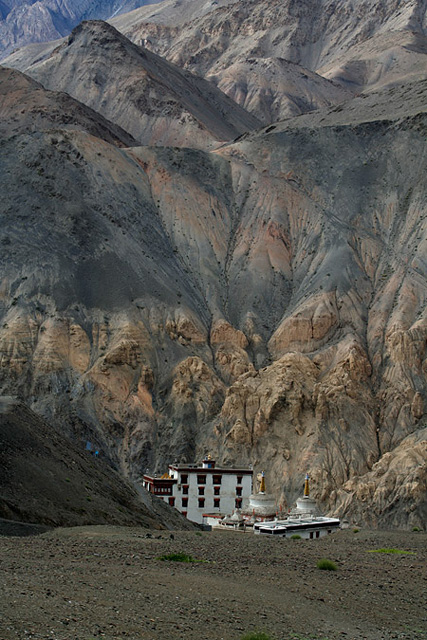
The most striking aspect of the Buddhist monasteries of Ladakh is their location. Ladakh is a remote region in itself and is separated from rest of the world by high mountains. Within it, the monasteries seem to look for the remotest possible place that keeps them away from everything worldly. Once, anyone who would like to make a visit would have had to make a slow and long climb in the rarefied air of Ladakh. Today, most of the monasteries are connected by road, though many still exist that only a few able people can approach. The Lamayuru Monastery in the picture, as you can see, is obviously in someplace faraway and remote. Yet, one can reach even here in a four wheeler. The monastery is believed to be established nearly a thousand years ago.
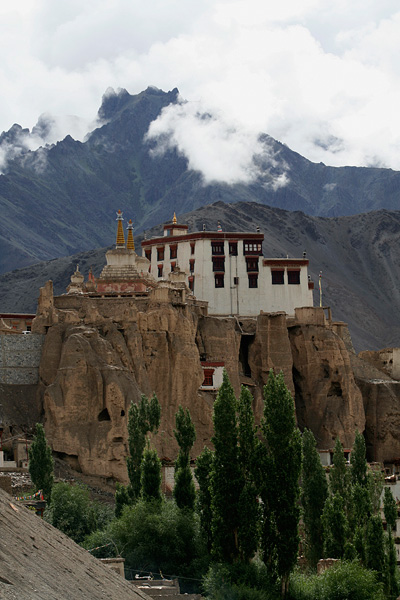
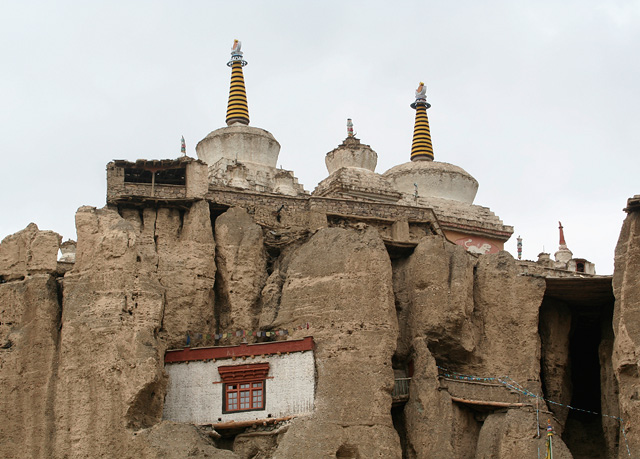
The setting of the monastery at Lamayuru Village is best described as queer. At the first sight, it appears to be hanging delicately on a mound that can collapse any moment. But it has seen a millennium pass by. Sections of the monastery go right under the ground and emerge on vertical walls, like in the picture above.
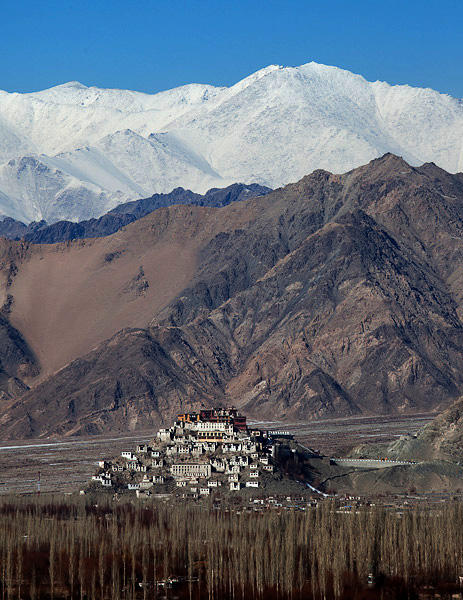
Most monasteries, like the one in Thiksey seen above, are located on a crag overlooking the village. They are built in a place not too close to the village, perhaps to keep away from the everyday life of the villages but at the same time near enough to offer religious services to the pious villagers. Thiksey is one of the largest monasteries in Ladakh, if not the largest. Its cluster of buildings spread haphazardly along a hill and the prayer hall located right on the top are often compared to Lhasa’s Potala Palace.
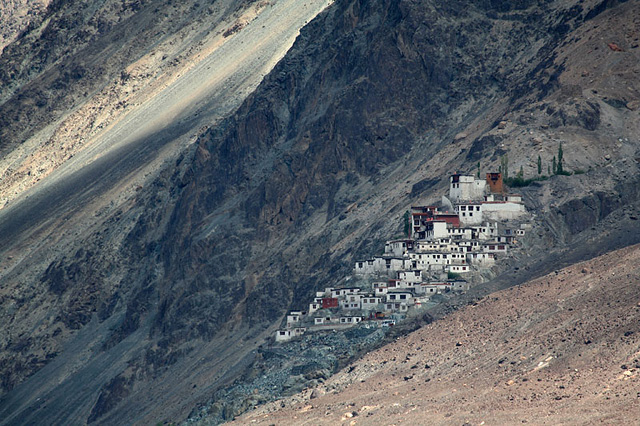
Diskit Monastery in Nubra Valley too is located high up the hill and a short climb from the village at the base of the valley.
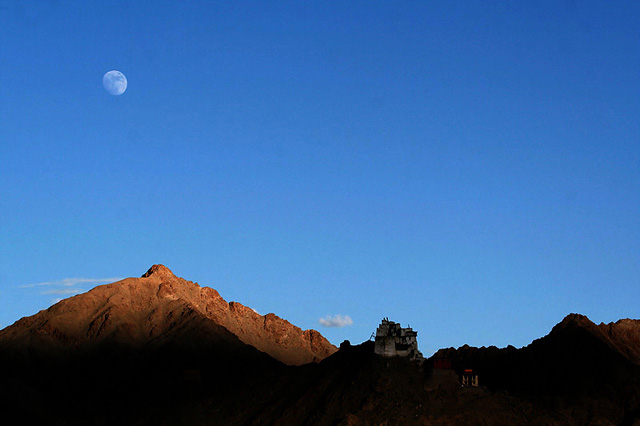
The Namgyal Tsemo Monastery high up the hill and visible like a beacon from anywhere in Leh Town is a great sight against the backdrop of tall hills that surround the town.
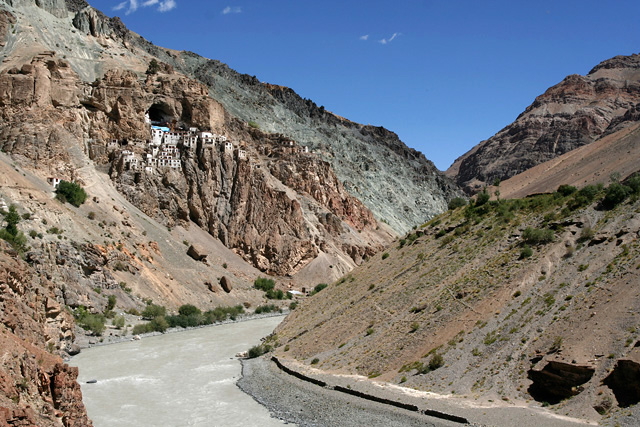
But few monasteries today are really as far away from every place as Phugtal Monastery in the picture above. Located inside a cave on the banks of Lungnak River, it takes two days of walking from the nearest road-head to reach the monastery. And the road head at Padum itself is a two-day of bus ride from Leh. But the distances are shrinking by the day. New roads under construction will link Phugtal in the next few years, and the distance from Leh to Phugtal will shrink to just a day in the next decade when new roads will be built along Zanskar River.
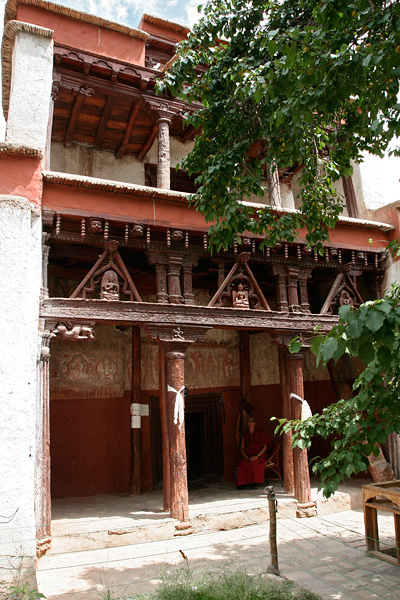
But the monastery at Alchi is an exemption to the trend of building monasteries in unapproachable places. One of the oldest monasteries in the region, Alchi is located on flat ground at the edge of the village, right next to fast-flowing Indus River. Alchi differs from all other monasteries in its design as well. Unlike other monastic institution built with the influence of Tibetan form of Buddhism, Alchi Monastery is said to be built at a time when Buddhism propagated here from Kashmir and the plains of India. The monastery is no longer an active institution, and is currently maintained by the neighbouring Likir Monastery. Rich, beautiful colour paintings have survived the onslaught of time in the inner walls of Alchi. Together with Tabo Monastery in Spiti Valley, Alchi is now in the list of tentative UNESCO World Heritage Site.
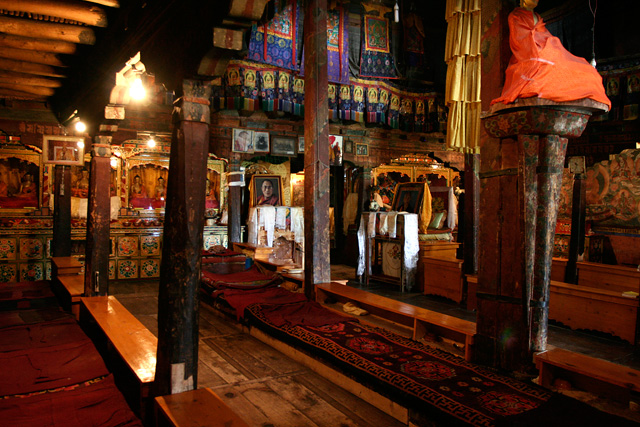
One of the most striking features of the monasteries is the richly decorated prayer hall. The halls are painted from wall to wall with deities and images of Buddhist iconography. The ceiling, the pillars, the seating and the tables, the altar are all decorated with colourful clothes and painting leaving not an inch of room empty, like the prayer hall or dukhnag at Thiksey Monastery in the above picture.
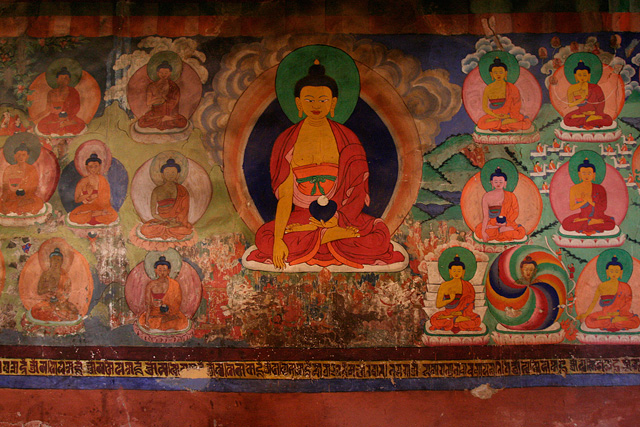
Several incarnations of Buddha, seen on the walls of Thiksey Monastery. Sometimes, the Buddhist iconography can be so detailed and complex that even the monks at the monastery may not be able to describe the details of every one of these murals.
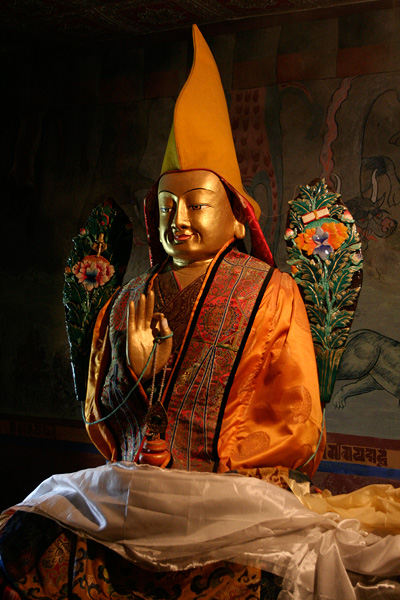
This statue of Tson-ka-pa, the founder of yellow-hat sect (or gelugspa), a popular form of Buddhism in Ladakh and Tibet to which the current Dalai Lama also subscribes to, is frequently seen in the prayer halls of several monasteries across Ladakh.
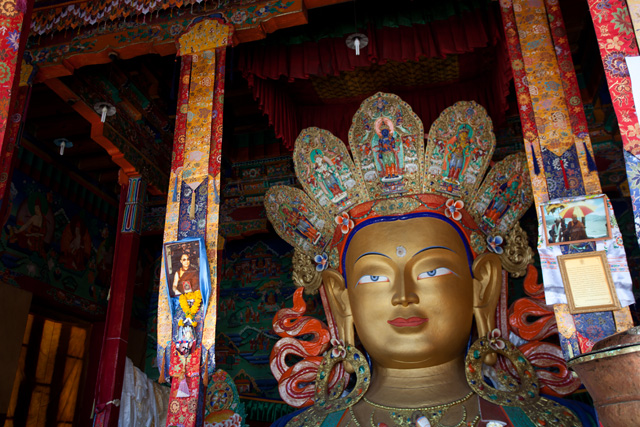
This richly decorated two-storey high statue of Buddha is another beautiful work of art, seen at Thiksey Monastery.
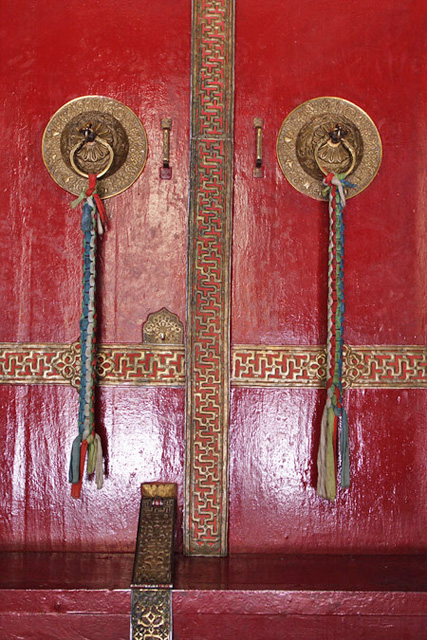
The painted doors of the prayer hall at Diskit Monastery, Nubra Valley, Ladakh
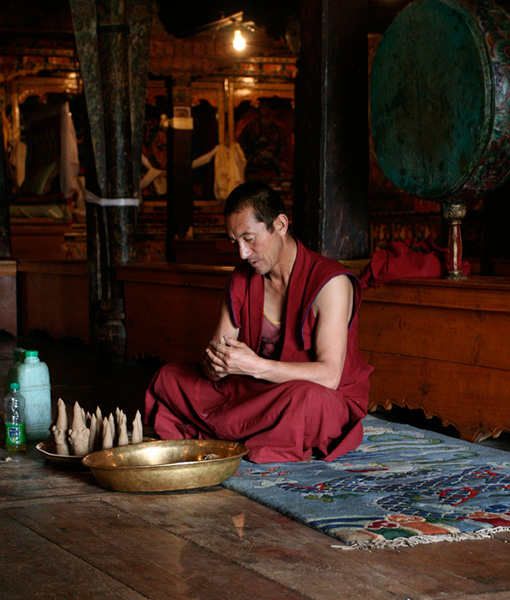
The prayer halls in the monasteries tend to be empty but for a caretaker monk for most part of the day. They come alive and get filled with monks during the morning prayer rituals and on the days when there are special pujas. This monk at Thiksey monastery is preparing torma (?) for decorations for an upcoming puja.
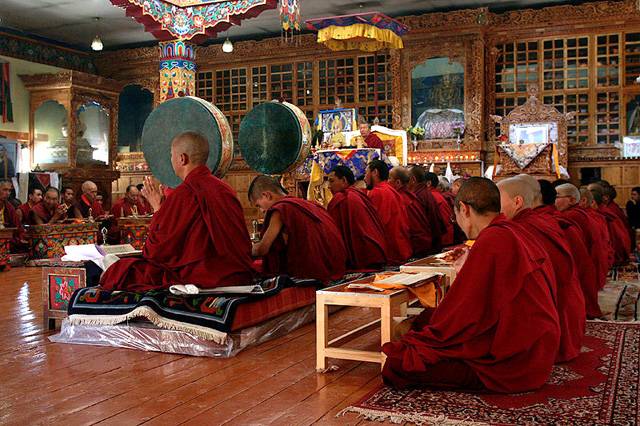
Monks gathered for morning puja at Leh’s Soma Gompa.
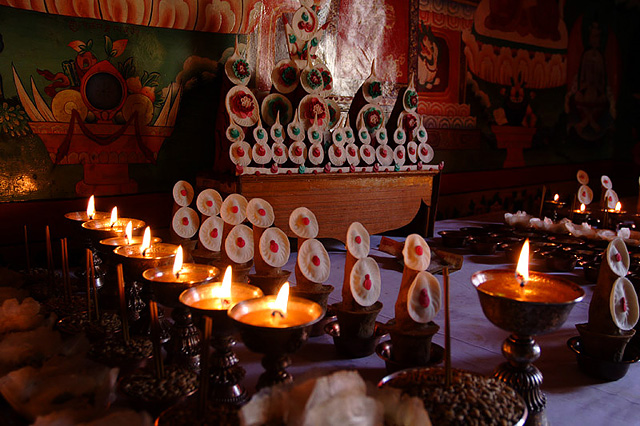
The prayer hall at Likir Monastery comes alive for a special Yamantaka Puja on the event of installing a mandala at the monastery.
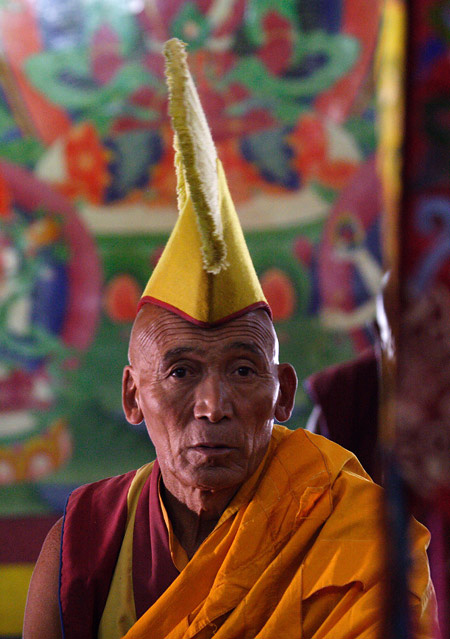
A monk looks on during a special puja at Spithuk Monastery, wearing the traditional yellow hat.
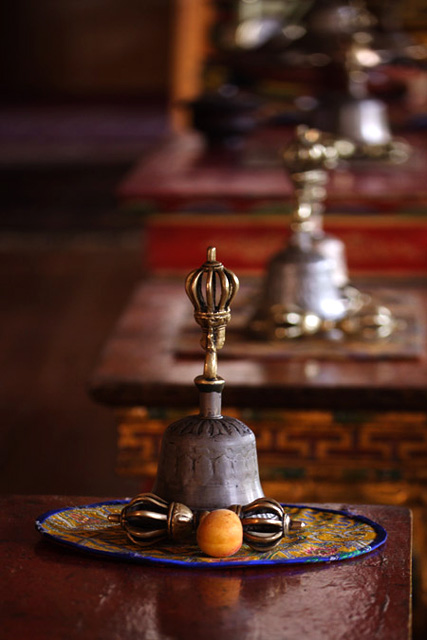
An apricot shares space with bell and a Vajra when the monks take a short break during a special puja ritual at Likir Monastery.
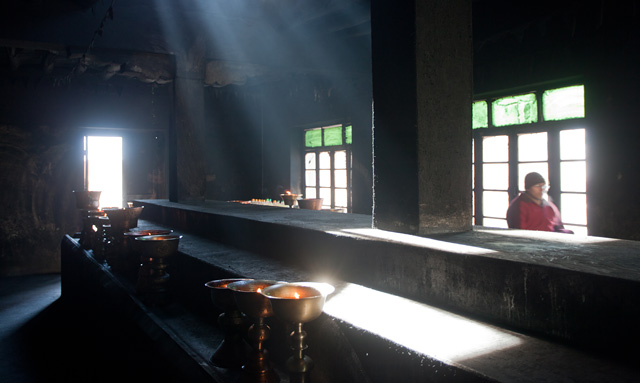
A room of lamp – a small area or a room dedicated for burning wick lamps is a feature of most monasteries in Ladakh. It is a beautiful place where several oil lamps of various sizes and shapes glow in the dull light coming from the windows.
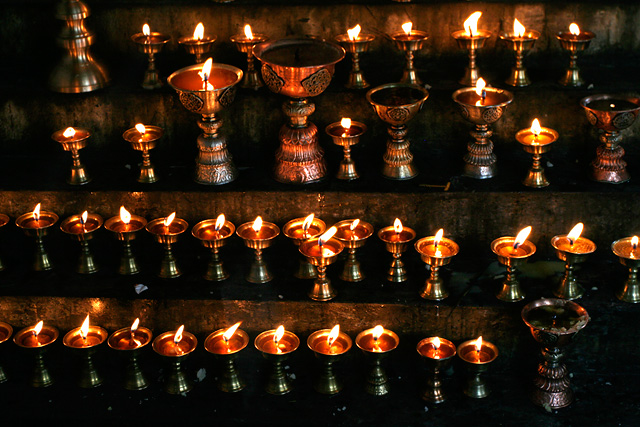
Another room of lamps, this one at Keylong’s Shashur Monastery, all lit up on the day of monastery’s annual festival day.
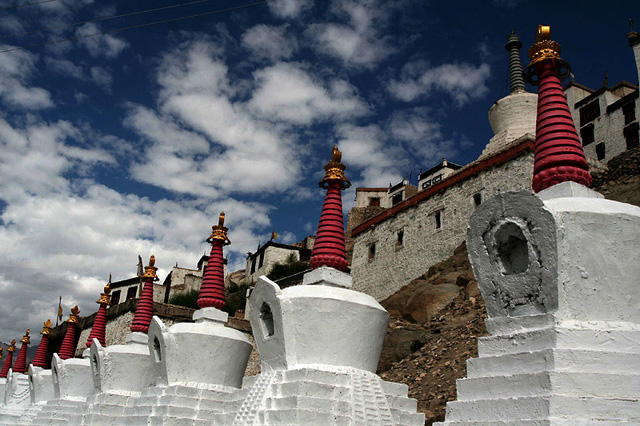
Chortens or stupas (?) are another dominant feature of the monasteries in Ladakh, usually seen in long arrays on the approach to the monastery.
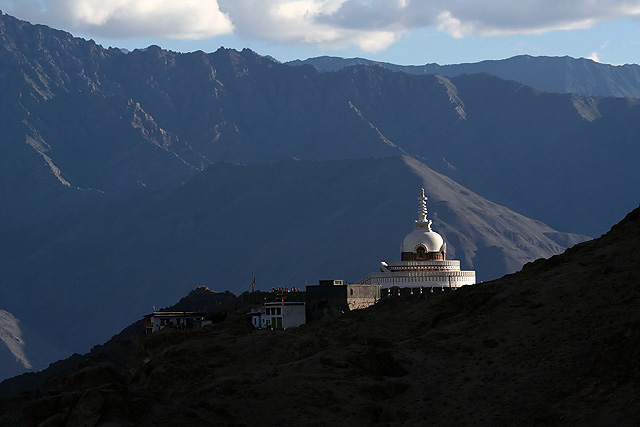
Shanti stupa is perhaps the most dominating and well-known chortens in Ladakh, located on the slopes overlooking Leh town. The views of, and views from Shanti Stupa give a grand preview of Zanskar and Ladakh Ranges and of the spread of Leh Town along Indus Valley.
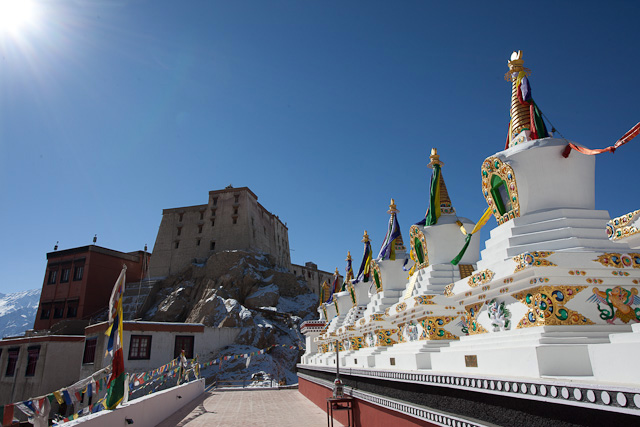
A line of newly built and freshly painted chortens at Thiksey Monastery.
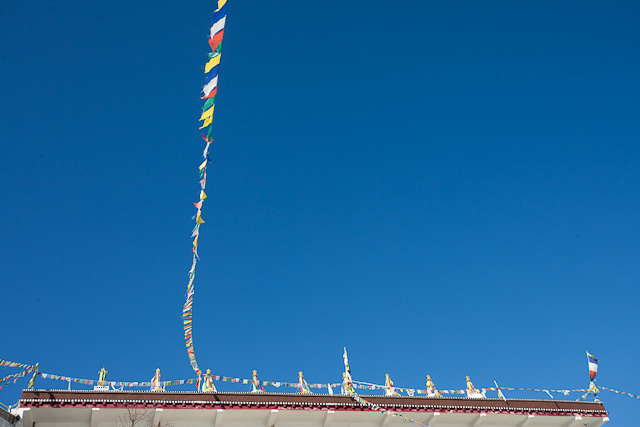
The flutter of prayer flags, a long line of chortens and the clear blue skies make a grand spectacle at Thiksey Monastery.
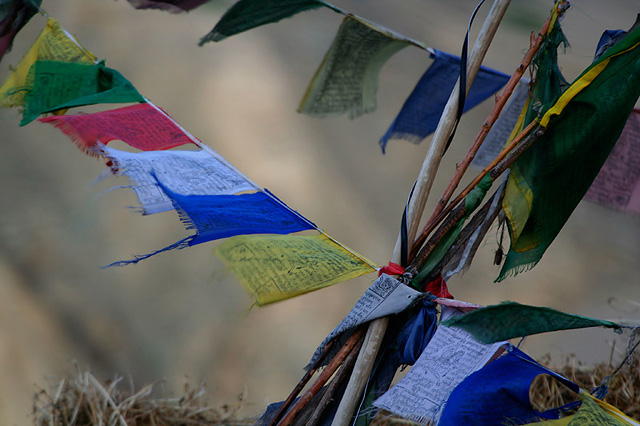
People of Ladakh tie prayer flags at all sacred and important locations. The prayer flags have sacred mantras written on them. Ladakhis believe that when the wind blows, the mantra from prayer flags is carried on and distributed in the air, bringing good karma.
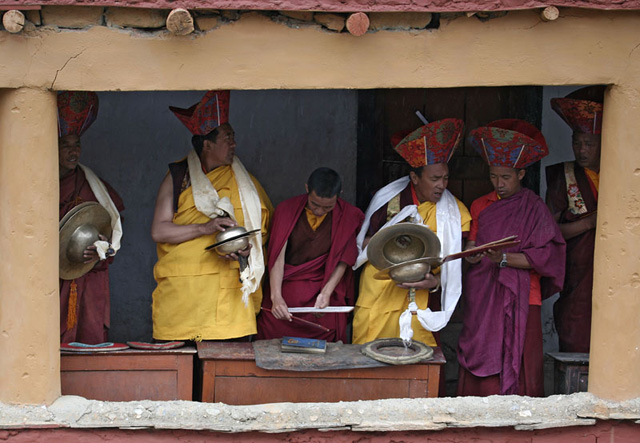
Once in a year, these monasteries celebrate their annual festival, when the premises will be buzzing with activity. The monks prepare for two long days of festivities which involves pujas, traditional music and dances. It is usually attended by the whole village and a large number of outside visitors.
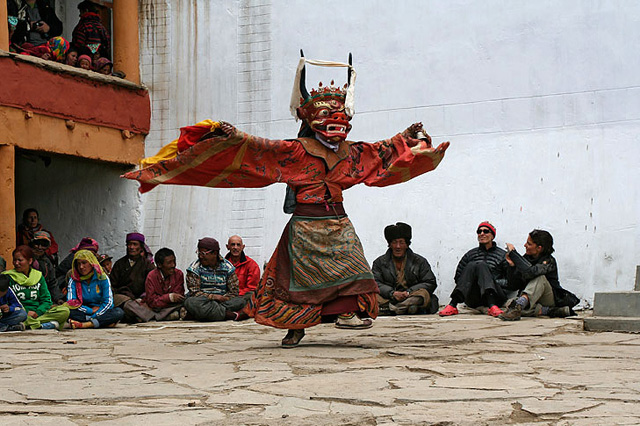
The most sought after event of the festival is the cham-dance, a performances by the monks wearing demonic looking masks.
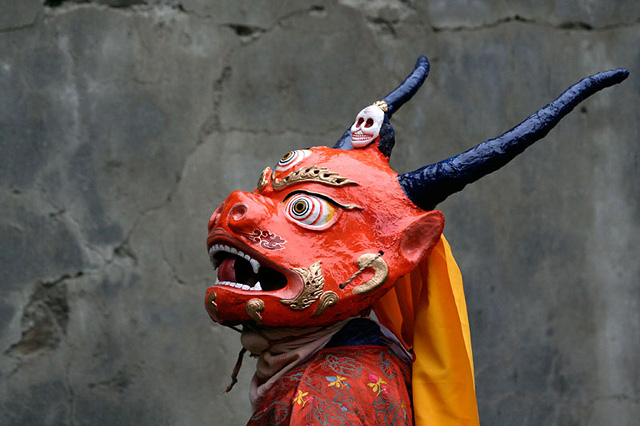
A masked monk performing at Gustor Festival at Korzok Village near Tso Moriri Lake.
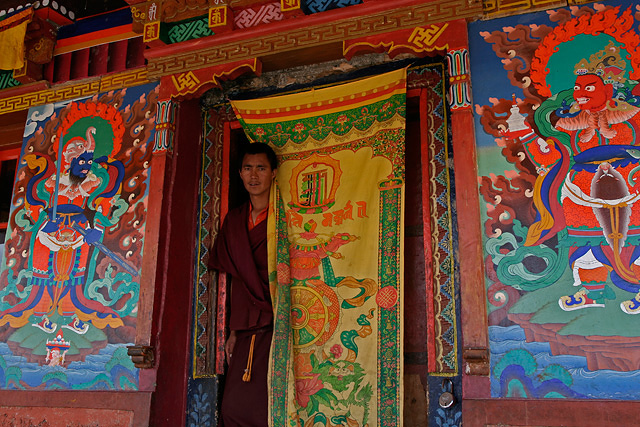
A monk looks through the doors of prayer hall at Korzok Monastery as they prepare for the festivities.
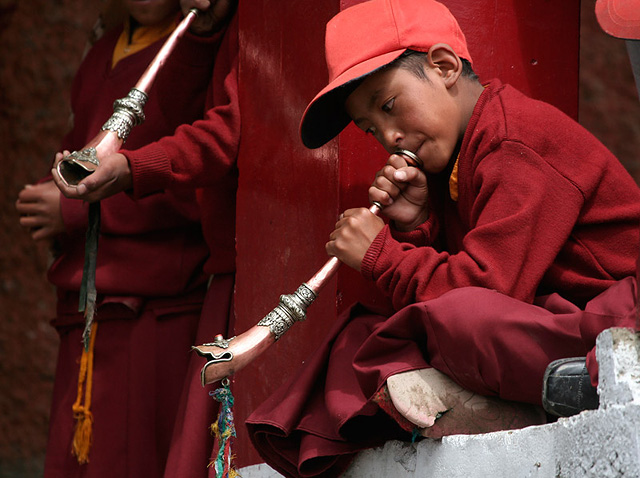
Young monks make an energetic participation at Korzok Gustor Festival.
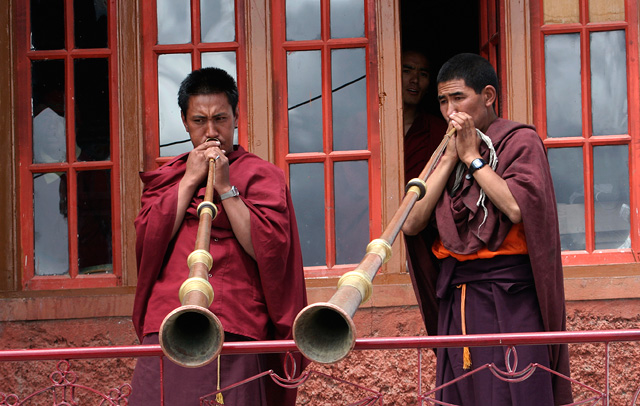
Dung chen, a long wind instrument is used to announce the arrival of rinpoche (chief monk) or the cham dancers. It is best compared to vuvuzelas, both in terms of their length and the sound coming from them.
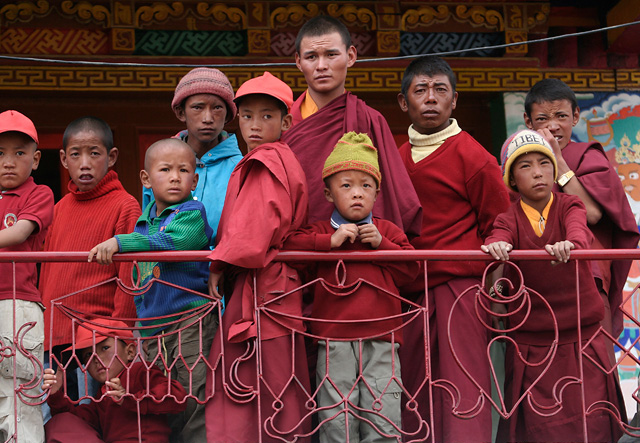
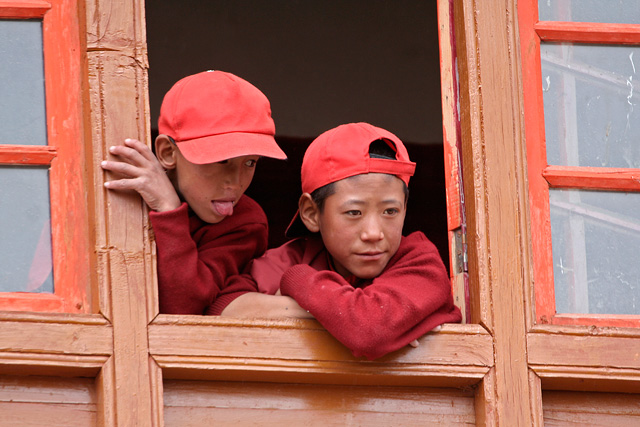
Young monks of different ages watch a cham-dance in progress during Korzok Gustor Festival.
The cheerful nature of people of Ladakh is infectious and easily rubs on to people visiting the region. It is perhaps one of the important factors besides magnificent landscapes and expansive lakes that attracts visitors from across the world to Ladakh. Here are some images of people of Ladakh.
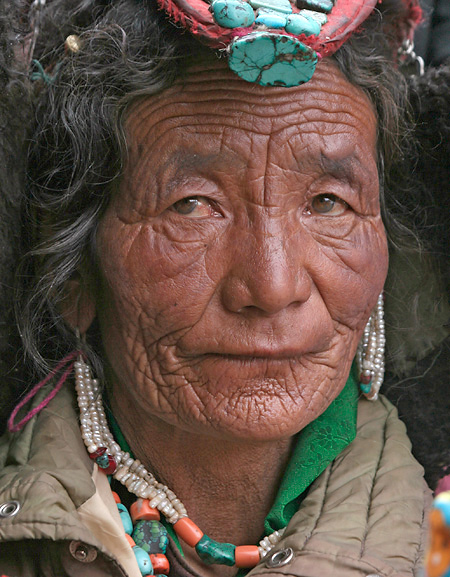
A lady at looks on as the annual Gustor Festival is in progress at Korzok Village on the banks of Tso Moriri Lake. The monastery festival is an opportunity for nomadic changspa people to get together and meet. Women adorn their turquoise jewellery and come dressed at their traditional best. People of all ages gather at the monastery, greet their friend and relative and celebrate the two-day festival that has a mix of tradition and revelry.
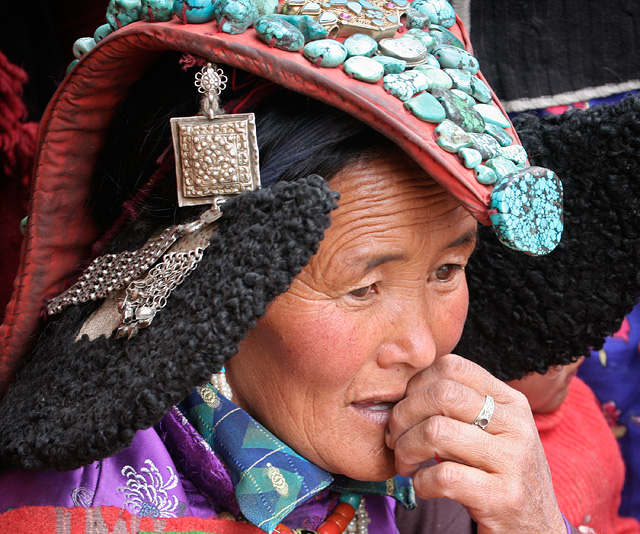
A changspa woman with her turquoise-embedded headgear at the annual Korzok Gustor Festival.
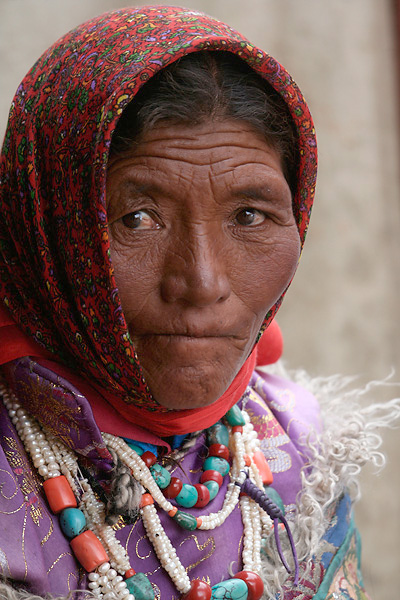
A changspa woman with her turqoise embedded jewellery at the annual Korzok Gustor Festival.
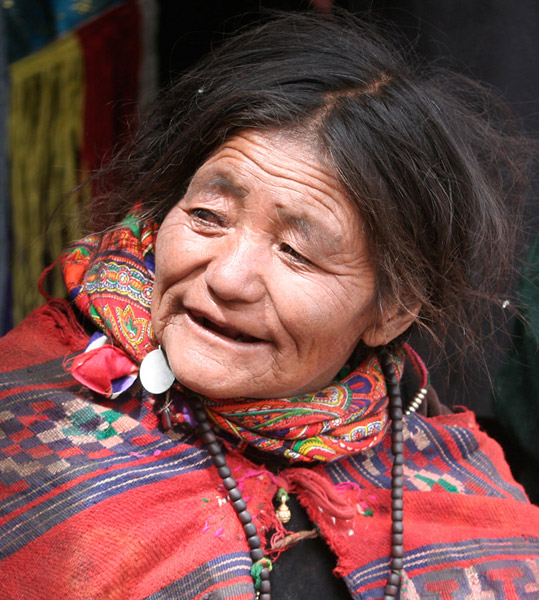
A changspa woman at Korzok Gustor Festival
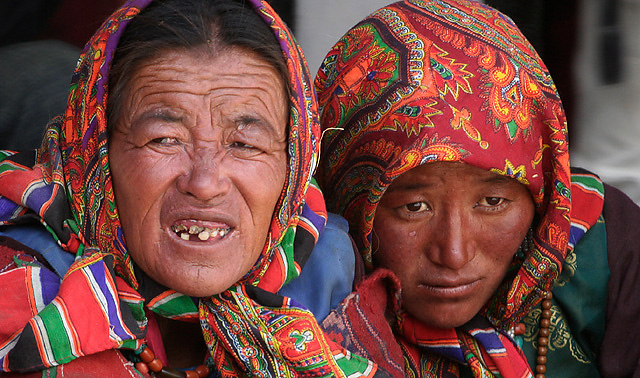
Changspa women at Korzok Gustor Festival
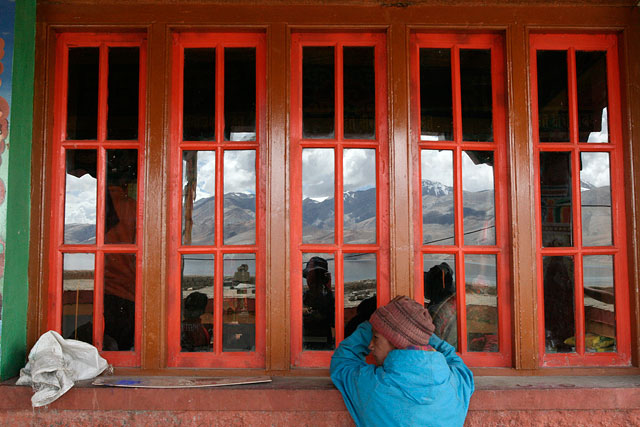
A boy peeks through the window of the prayer hall at Korzok Monastery to look at the monks getting prepared for the festivals in the room, while the mountains and Tso Moriri Lake reflect in the window.

Smiling children watching dancing monks at Korzok Gustor Festival
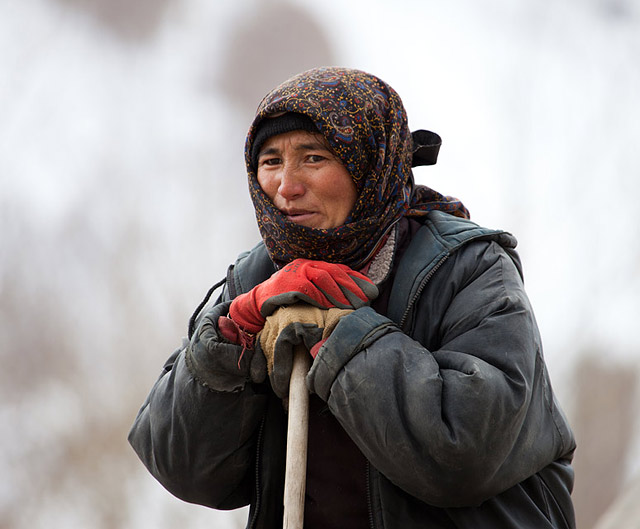
The remote Zasnkar Region gets cut off from rest of the world in the winter months, when the roads are buried in deep snow and the temperature dips 20 degrees below zero. But life must go on – the sheep have to fed, the stove must keep burning and the children must go to school. Children are going to modern schools in Zanskar only in the last few decades.
In winters, people of Zanskar rarely see new faces, except for a few adventurers who make the long walk on the frozen Zanskar River and stay for a few days in the villages before heading back. Such visitors incite the curiosity of the villagers who are always happy to begin a conversation and perhaps invite them over for a cup of tea.
This woman at Zangla Village takes a moment to talk to us at the end of day that is usually filled with lot of work even in the frigid winter months.
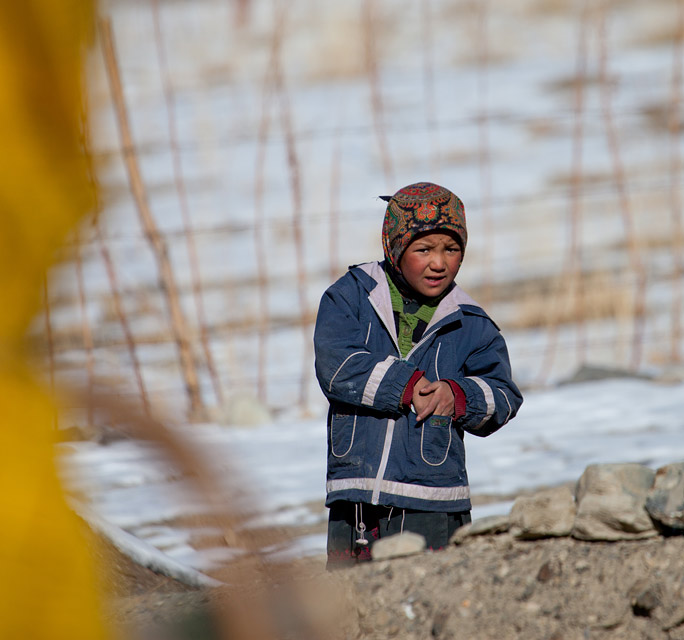
A girl pauses to speak to her mother before heading out to the school, where she will be spending her first half of the day.
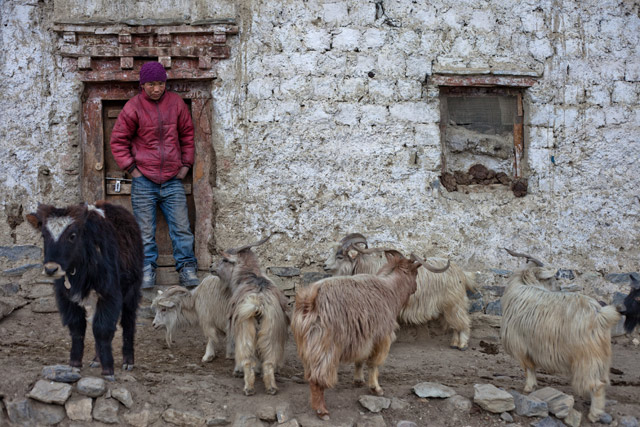
A young man has a short conversation with us before leading his sheep into a covered stable in the evening.
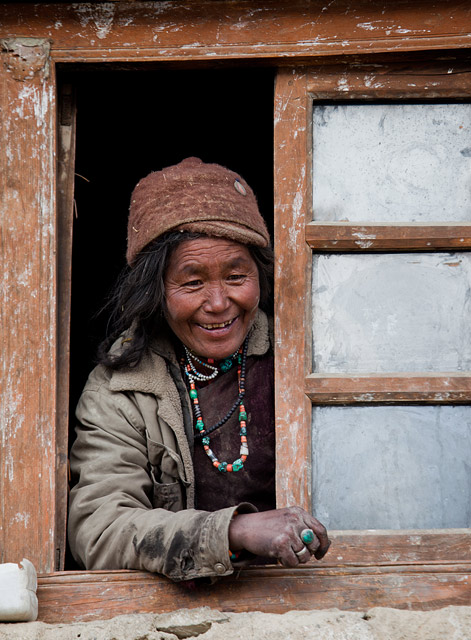
A lady is smiles at us looking through the window as we stop by to talk with her young lad taking care of his sheep nearby.
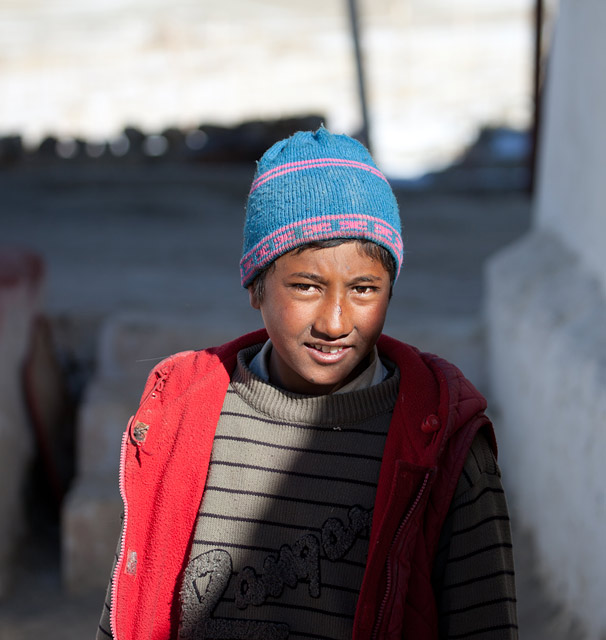
A shy boy at the house where we were staying in Zangla Village poses for the camera.
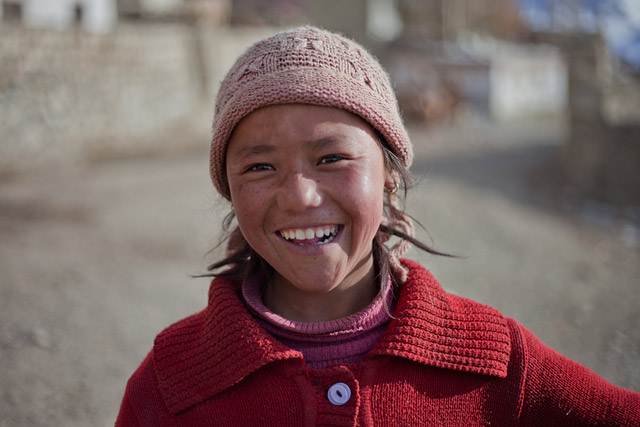
A girl smiles brightly as she starts a conversation and asks me to take her picture.
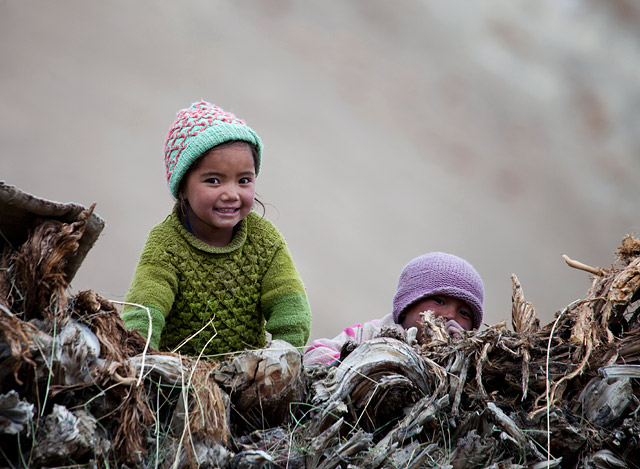
Children are happy to see new faces at their village on a cold winter evening. This little girl sang loudly to draw our attention, as her shy brother looks on hiding behind a stack of wood and hay.
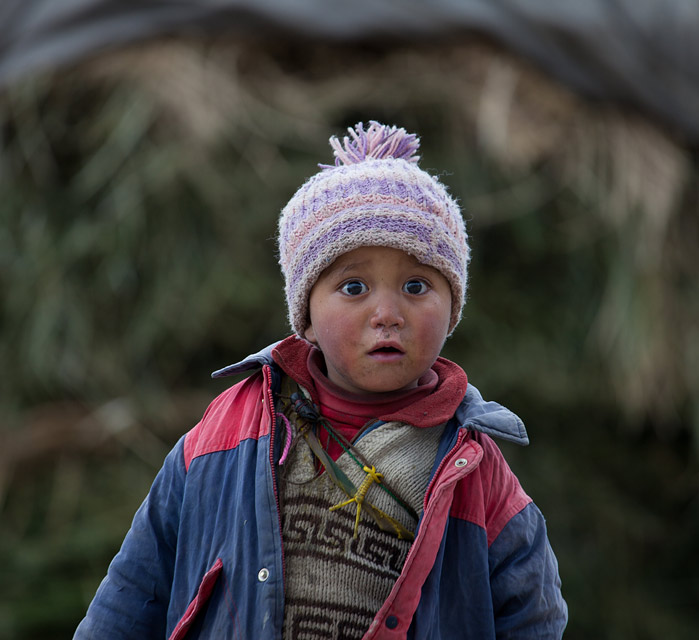
A curious young lad at Zangla Village, Zanskar.
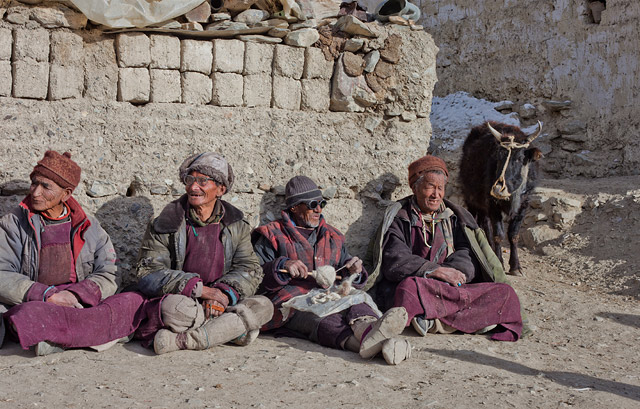
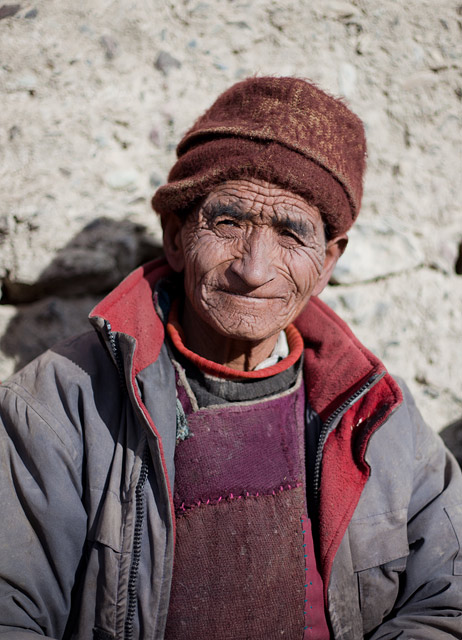
Traditionally, people gave up their ownership of land and home to their children after crossing certain age, built a khangbu—small house of their own—and retired to a life of simple living. I have never really seen a Khangbu anywhere in Ladakh. Perhaps this is a fading tradition, as I have seen houses where elders still share the family house.
In Zanskar’s Zangla Village, we saw this bunch of old men and women sunning in the evening. Some were busy knitting while everyone made some casual conversation, sometimes between themselves and sometimes with us.
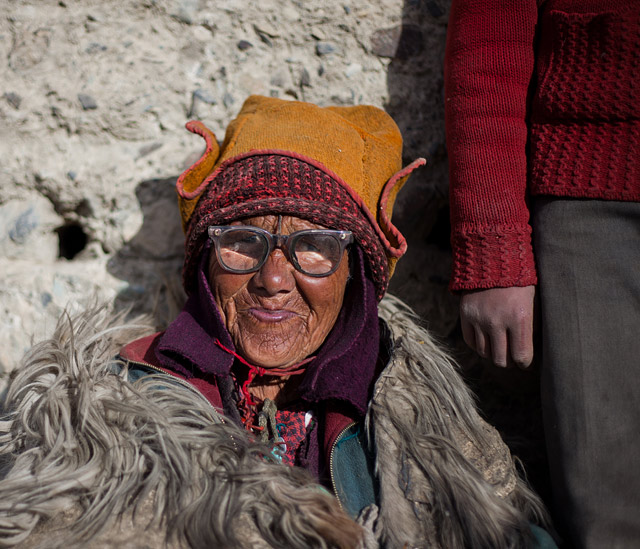
An elderly woman wearing sheepskin over traditional goncha smiles at us, while a young girl wearing a woolen sweater stands next to her.
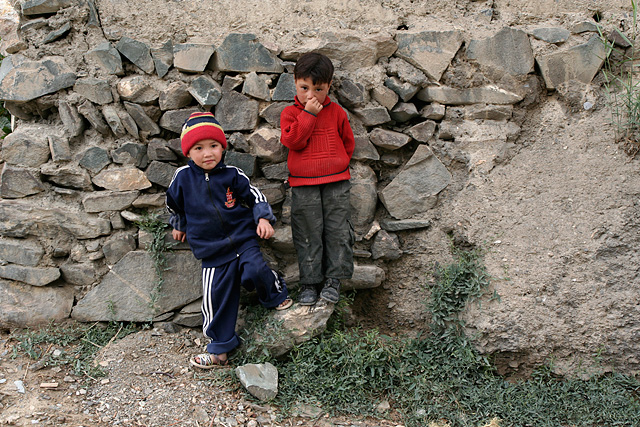
These children, who were playing quietly just outside their village at Lamayuru, pause briefly to look at the visitors.
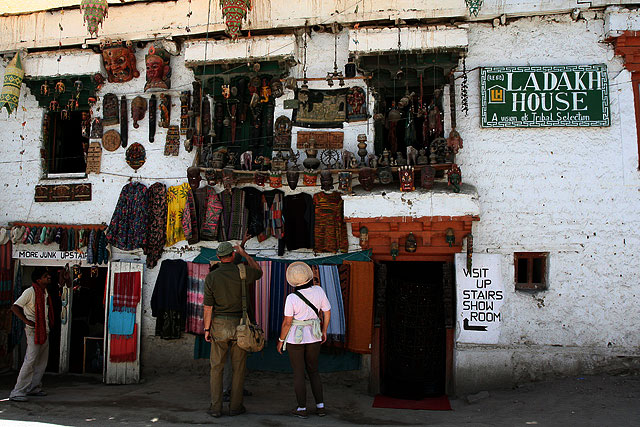
It is perhaps important to include tourists in the population of Ladakh, especially in the short summers when their numbers swell and perhaps exceeds the residents by manifolds. Leh, once a trading center and a town where several trading paths intersected and goods exchanged, now sees an influx of large number of visitors in the summer months when the weather is at its best. A good percentage of Ladakh’s population now depends on tourism income. This is also a time when there is a temporary immigration of a workforce that caters to tourists, who go back in the winter months when there are hardly any outsiders in the town.
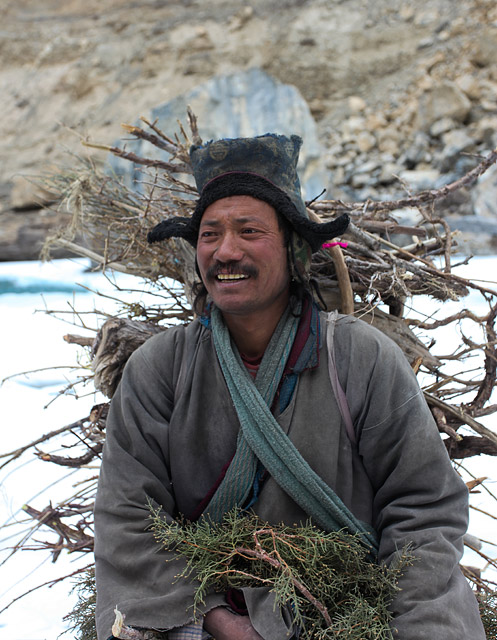
One of the great characteristics of Ladakhis is their abilities and physical strength to cope up with harsh weather and subject themselves to hard work. On a difficult expedition of walking on the frozen Zanskar River, Zanskari porters play the role of heroes who go to great extent to keep their visitors comfortable. They carry the luggages, cook and sometimes even carry trekkers on their shoulders when there is a need to step into the frigid waters. After a long day’s walk of pulling the load on their sledges, a porter still has the time for a big smile, and energy to collect a big load of wood by scouring the mountains.
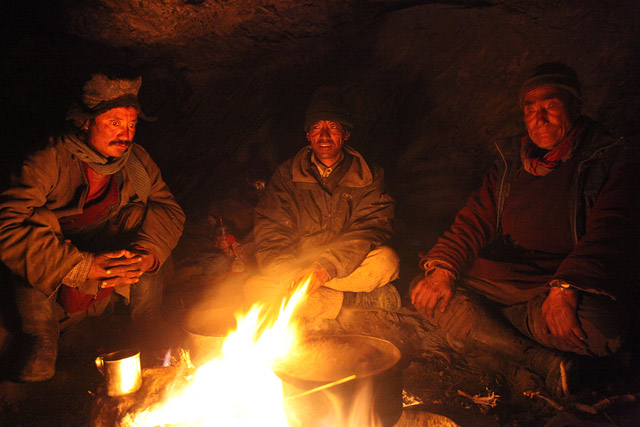
Porters warm up in a cave and cook their food as they get ready for a cold night with temperature reaching 20 degrees below zero in Zanskar.
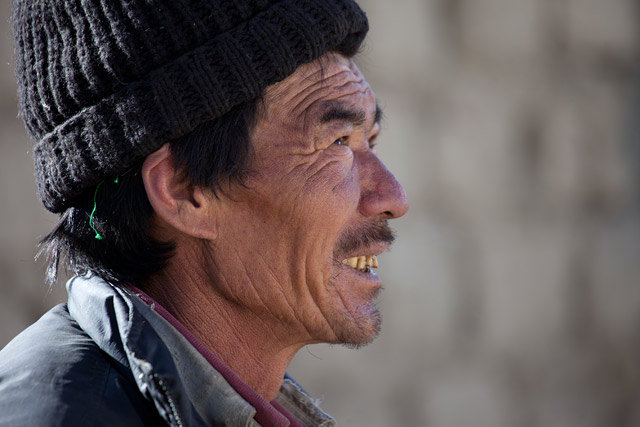
A porter who accompanied our group on the long expedition to Zanskar from Leh, walking on the frozen Zanskar River.
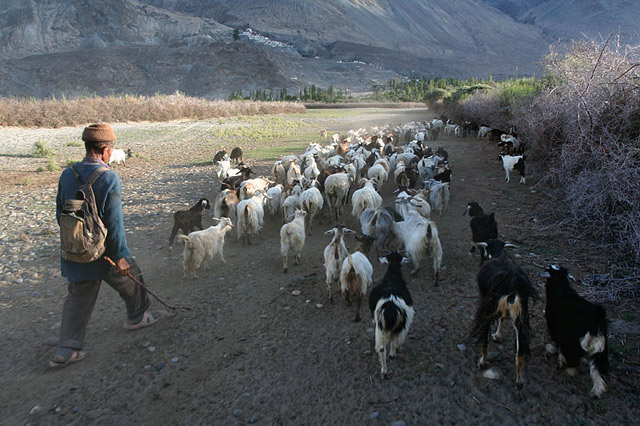
Sheep and Pashmeena Goats are an important part of Ladakh’s rural economy. While Barley fields take care of feeding the villages, Pashmeena Wool brings the much needed cash to buy everything else needed for the household. A shepherd is herding the goats back home after a day of taking them to graze in the wilderness of Nubra Valley.
Also read: my essays on the people of Ladakh.